On Tuesday, Apple CEO Tim Cook called for a comprehensive, national privacy law in the US at the International Association of Privacy Professionals’ (IAPP) Global Privacy Summit in Washington, DC.
Cook made the case for the foundational role of data privacy in quality of life – as well as the laws that will and won’t make it so.
The self-proclaimed data privacy activist pushed back – hard – against another bill, the Open App Markets Act. Apple claims its reason lies in the threat to data privacy. The Open App Markets Act, designed to loosen Apple’s grip in its app store, will compromise user privacy by making user data less secure, he said.
First introduced by Senators Amy Klobuchar (D-MN), Marsha Blackburn (R-TN) and Richard Blumenthal (D-CT) in August, the Open App Markets Act would prohibit Apple (and Google) from disallowing third-party apps on its proprietary App Store.
If the bill becomes law, it’ll require these “Big Tech giants” to pare back its anticompetitive gatekeeping of their app stores by allowing “sideloading” from third-party app stores. The idea is to promote consumer choice by giving startup apps a fighting chance on the market.

But the Open App Markets bill will roll out the red carpet to bad actors, malware and ransomware, Cook said. Cook compared the threat to several instances of ransomware disguised as COVID-19-tracking apps plaguing Android users by installing malware and stealing critical data.
According to Cook, the Open App Markets Act will bring the same dangers to iPhone users. “Privacy and security may not be protected,” Cook stressed. “Taking away a secure option leaves people with less choice, not more.”
To be clear, “Apple believes in competition,” Cook insisted. “We value its role in driving innovation and pushing us forward [as a society].” While the sponsors have pure intentions, he said, the “unintended consequences of being forced to allow unvetted apps onto iPhones will be profound.”
Cook’s speech comes in the wake of bills opening up the app store gaining momentum. In February, the Senate Judiciary Committee decided to advance the act with a landslide vote (20-2). And in March, the EU followed suit with a similar Digital Markets Act.
Federal privacy law
In calling for a federal privacy law, Cook said a national data privacy law will create checks on the power of new technology.
“Man cannot escape his moral responsibility by mumbling feebly, ‘The machine made me do it,’” he said. “Technology will continue to shape our world, but the societal impact is not predetermined. Technology has the power to enrich [society] and [fuel] innovation without invading people’s lives – the loss of privacy is not inevitable.”
One might familiarly say technology doesn’t hurt people; people hurt people.
Cook stressed that the answer to the problem lies in a law at the federal level, applauding the EU’s GDPR as well as the Brazilian counterpart, LGPD.
Cook has used industry conferences before to advocate for a national privacy law, including at an industry conference in October 2018, the same year GDPR went into effect.
Without data privacy, the world will find itself in a “data industrial complex” where anyone’s data can be stolen with impunity in the name of providing a service, he said. Businesses that rely on some degree of data – like advertising – “don’t need our permission to pierce so deeply into our private lives,” he said.
He compared data privacy breaches with real-life attacks and abuse. “Imagine if there was a stranger following your every move with a camera as you walk your child to school, or watching your every keystroke from behind you. You wouldn’t call that a service – you’d call it an emergency.”
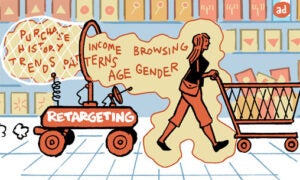
It’s why Apple maximizes the amount of data that’s processed directly on the device level, and prioritizes end-to-end encryption of its users’ data “without back doors.” Not to mention the rollout last year of Apple’s AppTrackingTransparency (ATT) framework to clamp down on apps using software development kits (SDKs) that combine developer data with third-party user data for ad targeting (which sent Facebook reeling).
The path to a national privacy law won’t be easy, but Cook argues the means justify the end.
“As much as we stand to lose in a world without privacy, I know how much we stand to gain if we get this right,” he said.