

With $2.3 billion in cash on the books thanks to IPG’s acquisition of Acxiom Marketing Solutions in July, the newly constituted LiveRamp is ready to start bankrolling its road map in a serious way.
“We didn’t have the technology muscle before and we weren’t investing in R&D,” said Scott Howe, who went from CEO and president of Acxiom to chief exec of LiveRamp when the AMS deal closed on Oct. 2. “But now we’ve got a couple of billion dollars we can use to accelerate everything we want to do.”
Top of the list are big investments in cleaner user interfaces and data integrations that will allow LiveRamp to explore entering adjacent sectors, such as financial services or healthcare, and power use cases that aren’t necessarily marketing related.
Imagine a universal patient ID that makes it easy to coordinate care across healthcare providers, Howe said, or using identity data to help a financial services company detect credit card fraud.
Beyond its cash on hand, LiveRamp is buoyed by enthusiasm in the market. Acxiom’s market cap before selling its data management business to IPG was around $3 billion. LiveRamp’s ballpark market cap after closing the deal is somewhere around $3.7 billion based on its mid- to high-$40s stock price. The company hit the market as a public independent entity under its own ticker – RAMP – at the beginning of October.
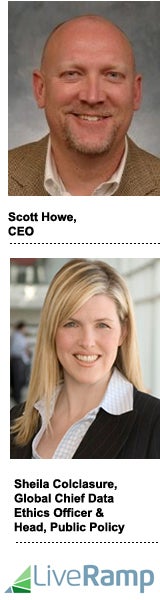
AdExchanger spoke with Howe and Sheila Colclasure, LiveRamp’s global chief data ethics officer and head of public policy, about what’s on the horizon for the slimmed down, cash-rich company.

AdExchanger: What’s the main thing that changed for LiveRamp since separating from Acxiom?
 SCOTT HOWE: Our competitors are becoming our partners. Monday morning of Advertising Week I appeared on a panel with the head of Epsilon’s data division. When I woke up that day, she was one of my biggest competitors. By late Monday afternoon, she was one of my biggest clients.
You must still have some competitors, though.
SH: Talk to some of the salespeople in the industry and they’ll say, “We compete with LiveRamp,” when in reality, most of the other identity solutions private-label us. Within the marketing and advertising space we have a pretty strong share. Where I get nervous is in adjacent sectors. For example, there are companies specifically trying to make government function more effectively by linking together disparate data sets.
The fear over time is that if we don’t successfully expand, one of these companies from another sector is going to say, “Maybe we should get into marketing and advertising.” So, LiveRamp has to be broader than we are now or we will invite the seeds of our own competition.
What about Facebook: competitor or partner/frenemy, now that Partner Categories are completely shut down?
SH: Partner. Facebook, Google, Oracle, Adobe and now Xandr are all really important partners, because they rely on the pipes we built to get advertiser demand to their door. If someone is onboarding their segments into Facebook, they’re probably using us. We don’t get paid by Facebook for that, we get paid by the advertiser, but we help drive Facebook’s success.
Speaking of being a facilitator, what’s up with the Advertising ID Consortium now that AppNexus is out?
SH: AppNexus has a lot of other things going on right now in terms of integration [with AT&T], so this has fallen off their priority list. My hope is that they’ll rejoin over time in some capacity.
This whole thing is about democratizing the data and the participation. If I have a beef with anybody in the industry at times, it’s that I wish the walled gardens would build a few more doors and windows.
That sounds like a description of your product road map.
SH: We want to make data useful everywhere. We started with digital media, and now you’ll see up light up point of sale, call centers, those things in the marketing world that drive customer experiences. We’re thinking about how to take what we’ve built, which is just wiring and plumbing to connect data, and bring it outside of marketing.
How does all of that innovation investment impact the job of the person in charge of keeping data safe, secure and compliant?
SHEILA COLCLASURE: It’s definitely more complex. But we intend to source data ethically, to really know the provenance and all of the rules. The innovation ethic is centered on understanding what is beneficial while detecting and preventing any harm.
Things like GDPR and the new California law are a great opportunity for us, because we’re framing our business around the idea of data ethics. And when partners come into our ecosystem, our ethics are extensible.
How do you make sure that the data you touch is ethically sourced?
SC: It takes a lot of discipline and hard work to get this right. Essentially, we interrogate the source all the way back to the origination of the data, including what notices were in place at the time, whether it’s a regulated class of data and the exact permissions and prohibitions. We automate this as much as possible.
SH: In some respects, the complexity is wind at our backs. Rather than telling clients they have to figure all of this out on their own, we’re there to help them, and that’s a halo to our business.
Which is why it was the right timing to get out of the marketing services business?
SH: There were two motivations. One, we believe the industry needs a neutral, agnostic player at scale. But there was also a strong financial benefit that we can’t gloss over. As a conglomerate, we had two really different types of business, one that was people intensive with lower service margins and slower growth, and the other a high-growth SaaS business. Having both of those under the same roof resulted in a discount to our valuation. Separating the two unlocks that trapped valuation for our investors.
How truly neutral was Acxiom before the spinoff?
SH: LiveRamp has always been completely neutral, but being adjacent to Acxiom was sometimes misinterpreted by our partners. For example, LiveRamp powers Merkle, Epsilon, Experian – all competitors of Acxiom for decades. There was always this challenge of competitors not wanting to deepen their partnership with us out of fear that one of our divisions would share cash and insights with the other.
We never did that, but perception is reality. But that’s evaporated now and there’s nothing to fear.







