


Most marketers know they need data management platforms and a growing number have either already implemented one or plan to do so soon.
Yet marketers in some industries, such as manufacturing and education, are seriously lagging in DMP adoption, according to a survey released Tuesday by market research firm The Relevancy Group.
Forty-one percent of the 301 senior ad and marketing execs it surveyed already use a DMP, while 39% intend to bring one on board within the next year. Forty-one percent may sound high, but that number is being driven by certain very fragmented, competitive and consumer-facing industries.
Media and publishing (53% implementation rate), travel (45%), financial services (44%) and retail and consumer packaged goods (40% each) are going full steam ahead.
These industries are early adopters out of necessity, said Relevancy Group principal analyst Peggy Reinders.
Publishing and media houses need data to justify their CPMs. Travel companies must navigate the complexity around customer intent and the ever-shortening trip-planning cycle. Retailers need to take better advantage of their data as they struggle to compete with Amazon. And CPG marketers need to work around often having no direct relationship with consumers.
But there are still some holdouts. For example, only 25% of manufacturing companies and 36% of education marketers use a DMP.

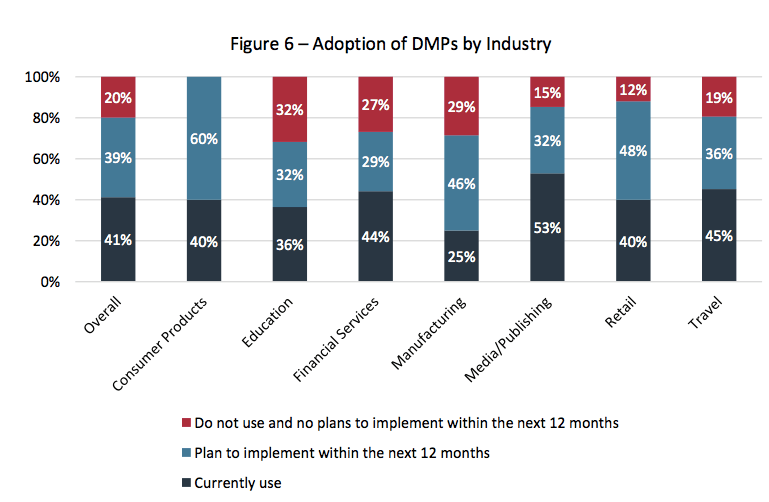
Every CPG brand surveyed that hadn’t already implemented a DMP said that it’s on their 2017 road map. But interestingly, a small minority of marketers in other high-adoption industries said they have no interest in a DMP, at least not within the next 12 months. Twenty-seven percent of financial services marketers, for instance, said they have no intention of partnering with a DMP this year, and neither do 19% of travel companies, 15% of publishers or 12% of retailers.
Only 21% of financial services companies said a DMP is extremely important in their advertising and marketing plans, while 50% of manufacturing marketers – generally stragglers when it comes to mar tech adoption – view DMPs as critical. Forty-six percent of manufacturers have DMP implementation on the agenda for 2017.
This muddled picture clearly points to the need for education and more evidence in action, Reinders said.
“The lack of education is certainly affecting the pace of adoption,” she said. “Marketers are looking to build strong business cases to overcome challenges like privacy and the lack of data centralization, but they’re not getting enough help on that.”
There’s a “huge opportunity” for vendors and trade orgs to step in and help marketers make the case for DMP implementation and people-based marketing to the C-suite, with proof points tailored to a brand’s needs.
“It’s not a one-size-fits-all sort of thing,” Reinders said.
But despite a lack of guidance and slow start, brands are beginning to see results from their DMP implementations. Relevancy Group found that 15% of marketers using a DMP or other identity management solution have higher email click-through rates than those who aren’t.
CMOs need that sort of information if they’re going to invest in mad tech – the combination of ad tech and mar tech.
“Marketers are mostly operating off of faith right now, and CMOs are not going to just decide to spend millions of dollars on something without business cases,” Reinders said.
One such business case is lowering the buy side’s overdependence on Facebook and Google. That’s also a big reason behind why Time Inc./Viant’s recent acquisition of Adelphic is appealing, Reinders said.
“Marketers need scalable, people-based advertising solutions outside of the walled gardens,” she said.
Marketers are probably never going to get the full individual customer view they need from the larger platforms, Reinders said, but they can reduce their reliance on Google and Facebook by using a DMP to house their own first-party data and integrating other data sources, including second- and third-party data, for scale. That’s another step toward identity resolution of data points around a core identifier.
“If marketers have their own solution, it means they don’t always have to go to Facebook and Google,” Reinders said. “DMPs can help marketers get that full picture they’ve always wanted.”








