 In recent months, Evidon has pushed to get more people to use Ghostery. As of Monday, everybody who uses Evidon will by default be using Ghostery, because the entire company is taking the name of its popular browser app. More specifically, Evidon will become Ghostery Enterprise.
“We’re refocusing on the concept of transparency for everyone,” said company COO Emily Riley. “If you look at what consumers do with Ghostery and what our enterprises do with Ghostery Enterprise, it’s the same thing but looking through either end of the telescope.”
What she means is that while consumers using the Ghostery add-on can see which vendors are tracking them, businesses using Ghostery’s enterprise product can see which vendors they have relationships with – a practice Ghostery calls “Marketing Cloud management.”
The problem, as described by Evidon (now Ghostery Enterprise) CEO and founder Scott Meyer, is that enterprises might have direct relationships with a handful of advertising and marketing tech vendors. But those vendors have relationships with other tech partners that the enterprise customer does not know about.

Consequently, numerous tags and trackers exist on a branded website, without the site owner’s permission, siphoning away customer data and slowing down site performance, which – as prospective customers bail – can lead to lost sales opportunities.
It’s like a house party gone out of control, in which invited friends each invite acquaintances of their own, each of whom invites yet more acquaintances.
“On average, the top retail sites deploy 74 different marketing cloud vendors, and only 20% are directly placed by the site’s owner,” Meyer said. “One of our big retail clients came in and said, ‘You mean I’ve got 189 different pieces of marketing cloud technology deployed on our website and I’ve got direct relationships with 39 of them?’”
Ghostery’s toolset is designed to expose all of that, for instance revealing tags placed on a website that haven’t been collated by the tag-management system. In a survey Ghostery conducted of 50 top retailers in the United States, the company noted that on average 72% of tags overlapped – placed by competing ad tech vendors.
Ghostery claimed that when Telegraaf Media in the Netherlands implemented its solution it managed to reduce “detrimental tags” by 73%, consequently increasing the speed of its other tags by 62%.
The Ghostery Enterprise rebrand marks a big push for the company toward enterprise customers. It’s one of the reasons Riley came on board in January. While these enterprise tools aren’t new – the company has offered them, under the Evidon name, for roughly a year – traction among enterprise clients is picking up. Ghostery Enterprise claims north of 50 customers, 30 of whom came on in Q1 2014.
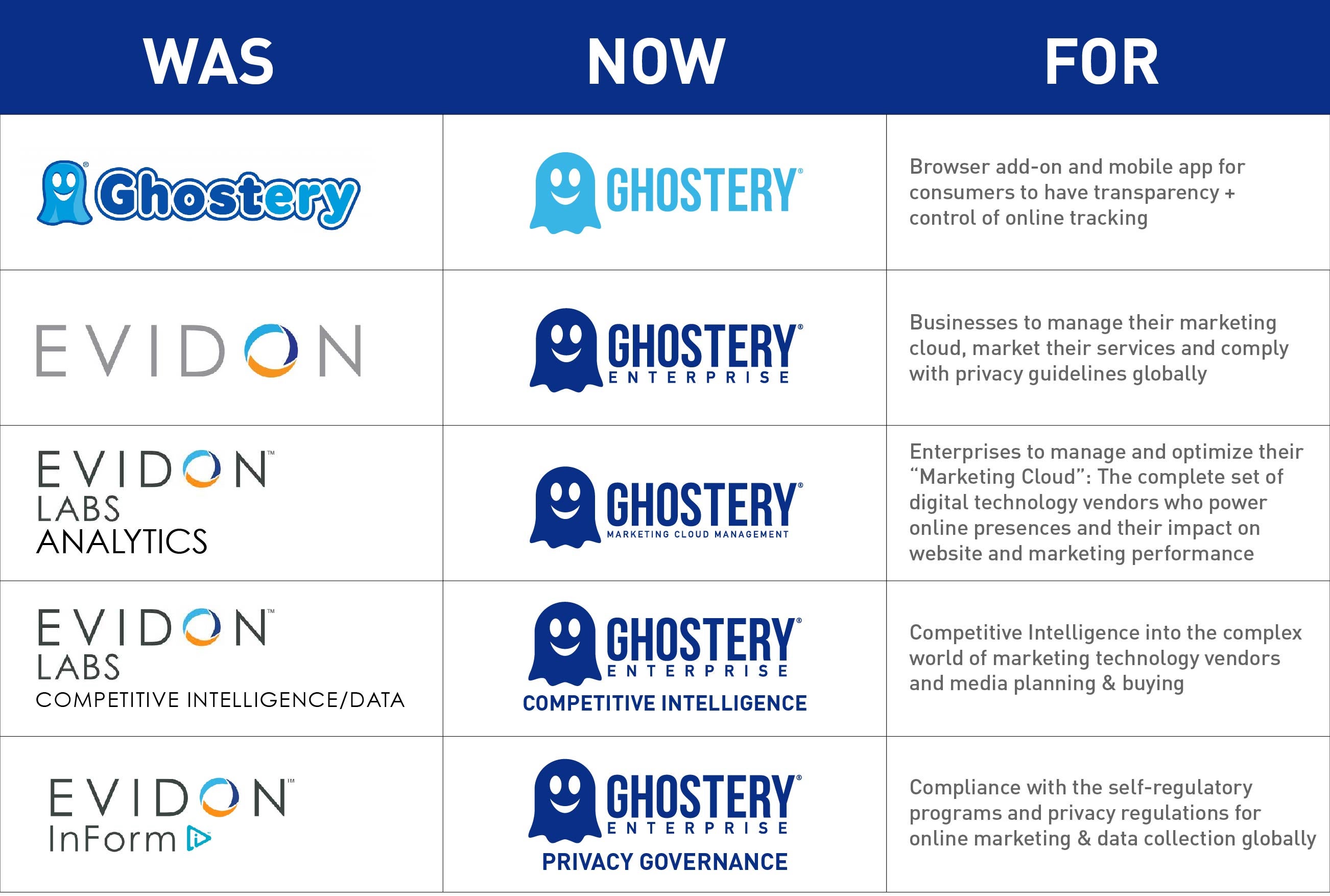
Here’s a rundown of the exact changes:
Riley said she sees 2014 as a particularly opportune year for Ghostery, considering the rash of data breaches that occurred in 2013. These breaches, she said, have scared many enterprises into taking data governance seriously.
“Now that you have programmatic advertising taking a lot of money out of the digital spend each year, there’s more nervousness,” she said. “Suddenly, there’s a black box and a lot of people don’t know who they’re working with or where their ads are showing up. 2013 was a very big year for things that are scary for traditional marketers and ecommerce companies. They saw a lot of risk being put in front of them and they’re aware that the digital advertising space isn’t a panacea they might have thought at the beginning of this year.”