
On the eve of Oracle Open World, the enterprise giant’s Data Cloud hopes to position its data management platform (DMP) – the one inherited from the BlueKai acquisition – as the focus of a tech stack that includes identifiers from AddThis and Moat, onboarding from Datalogix and cross-device linking from Crosswise.
There are a couple of changes here.
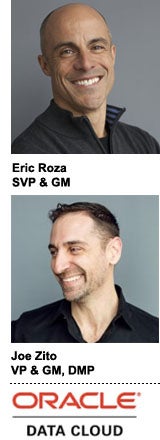
First, when Oracle bought BlueKai in 2014 – an acquisition that included both a DMP and a data exchange – the data exchange went to the Data Cloud, overseen by former Datalogix CEO Eric Roza, and the DMP went to the Marketing Cloud, now overseen by Laura Ipsen.
A few months ago, Oracle moved the DMP into Data Cloud.
“Historically, there was a split,” said Roza, SVP and GM of Oracle Data Cloud. “Engineering and development for the DMP sat in the Data Cloud, because of the shared backbone. But the go-to-market was in the Marketing Cloud.”
But despite synergies with marketing cloud tech, such as Responsys email marketing or Eloqua marketing automation, the DMP’s connection with third-party data was so tight that it made more sense to reunite the platform with the BlueKai data exchange – and by extension, place it into Data Cloud.

That leads to the second change: Oracle is integrating its other Data Cloud assets into the DMP so that it can more fully meet its clients’ data needs.
That includes onboarding both first- and third-party data, matching identities across desktop, mobile devices and across walled gardens through Data Cloud’s partnerships with Facebook, Snapchat and other networks.
That aspiration is significant because Oracle DMP – née BlueKai – is an OG DMP with great legacy and name recognition. But that legacy meant it was originally designed to aggregate third-party data, which provided ammo for upstart competitors like Krux – now owned by Salesforce – which also harness clients’ first-party data.
So, by expanding the types of data its DMP can harness, Oracle Data Cloud is attempting to negate that common competitor talking point.
At the same time, it’s emphasizing its own strengths as a third-party DMP. Despite marketers’ recent love affair with first-party data, Roza argues that the ability to harness third-party data is equally if not more important.
“If you look at DMP usage, 90% or more is pumping online data to open web platforms via cookies,” Roza said. “It’s not just about first-party data, it’s heavily about third-party data. And it wants to go into all of these walled gardens, into these mobile devices, accurately and at scale. So, the first-party DMP model is a little out of step with where the industry is going.”
Joe Zito, the Oracle GM and longtime Datalogix exec who’s spearheading the DMP effort, claims that most other DMPs are “glorified tag management and segmentation platforms.”
One of Zito’s initiatives is to customize the Oracle DMP for 10 verticals: automotive, CPG, retail, restaurants, financial services, B2B, travel, telecom, tech and media and entertainment.
“The vision for the DMP – to unify what you’re doing across marketing channels – has fundamentally failed,” he argued. “Yet it’s not core infrastructure. People hop from one DMP to another.”
Cynics would note that the deeper integration promised by Oracle Data Cloud likely creates more vendor lock-in and deters migration to DMPs from, say, Adobe or Salesforce. Though, of course, the enterprise tech giants are at constant war, and Adobe and Salesforce are equally invested in locking in clients.
Finally, it’s also important to point out that Oracle Data Cloud’s vision – to combine the DMP with the rest of Data Cloud’s assets – is still a work in progress. Onboarding from Datalogix, for instance, is fully baked in.
“There is a bit of development around advanced identity management – like connecting a client’s internal IDs to anonymous IDs in a way DMPs don’t do today, and connecting to TVs,” Zito said.
And new functions also require new workflows. “We’ll need to refresh the UI/UX in its entirety when we bring in cross-device and all of these new pieces of functionality,” Zito said. “We don’t want this to be a Frankenstein.”
Finally, Oracle will also need to integrate metrics and analytics with the data feeds that come in.
These are not incidental changes. Roza says the full transformation will take months.
Still, Oracle Data Cloud is making strides to further differentiate itself in an increasingly competitive market.