
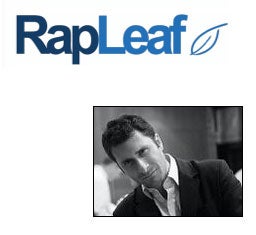
Auren Hoffman is CEO of Rapleaf, a company which provides social data about a company’s audience.
 AdExchanger.com: Tell us about Rapleaf‘s history.
AH: Rapleaf’s vision is to understand people. Like Google understands URLs, we want to better understand people.
What problem is Rapleaf solving?
At our core, we’re about helping companies understand their existing customers and find new customers. We do this by analyzing the “social data” of people. Social media data (blogs, forums, social networks, discussion boards, etc.) is an emerging source of information on people. Rapleaf is helping organize the massive volume of public data being made available, and providing that to end users in meaningful ways that provide unique insight.
What is your core dataset?
We focus on social data – which includes the social graph, interests, affinities, and demographics.
AdExchanger.com: How are clients buying audience with Rapleaf’s help? And, do you work with demand-side platforms?
Today, Rapleaf is plugged into several DSPs, and we work with several ad networks. We offer unique segments like “Online Influencers”, “Active Twitter Users”, “Fans of X Brand”, etc. Advertisers come to us today to buy audiences that have affinities with their brand and also a high potential to spread a message online.

Who is in your competitive set? Why?
We’re a data provider, so our model is not about selling media space, but more focused on providing targeted audience data.
What are you focused on beyond display? How do you see this product like working with display-related product initiatives?
We help companies both acquire customers and better engage their current customers. To acquire customers, we help companies better target their display advertising. Display advertising can be effectively used to find the right audiences for your product. We also help companies engage their current customers by understanding their customer base for email, on-site outreach, and retargeting… We do a lot of work with retailers, hotels, airlines, large brands, and more to help them better understand their customers for personalization and advanced targeting.
Can you explain how your social data works with brand marketers?
Social data is different than in-market data, as it does not necessarily indicate intent, but instead it indicates a persistent affinity to something. For example, if you follow “Apple” on Twitter, you may not necessarily be looking to buy a Mac at this moment, but you are a brand advocate and represent a certain profile to brand marketers.
What are your thoughts around online data exchanges? Are you or will you use them?
We’re testing several data exchanges and think they have a future in organizing data. We think they will play a very important part making advertising on the Internet more relevant and less spammy. We likely will grow the exposure of our data in the exchanges over the coming months, as the combination of our data and intent data (i.e. an Apple fan who is in-market for a computer) can be very powerful.
What’s the biggest pain point for Rapleaf for its product lines?
Reach is one of the most important things for any data provider, and we’re always investing in growing our reach. Additionally, it’s important to get close to the media buyer. But our biggest pain point will also be finding and hiring great people … we encourage your readers to learn about Rapleaf and apply here.
Any thoughts on how web publishers should be managing their data? What sort of tips might you have for the publisher given your data specialization?
Publishers can think creatively about what unique data set they can provide. Most importantly, however, publishers should focus on what they do best: providing amazing experiences to their audience.
Follow Auren Hoffman (@auren), RapLeaf (@RapLeaf) and AdExchanger.com (@adexchanger) on Twitter.








