

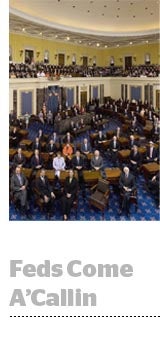
 A Wednesday hearing held by the US Senate Committee on Commerce, Science and Transportation about the operations of so-called “data brokers” highlighted the disconnect between data marketers and consumer advocates. The hearing followed the release of a report detailing the findings of a yearlong investigation into data marketers.
The core disagreement revolves around the extent to which businesses trafficking consumer data for marketing purposes should be regulated; opponents say regulations would hurt small businesses and the economy and that the industry adequately self-regulates, whereas proponents say that the current system, due to its lack of transparency, throws consumers at the mercy of potential scammers and disreputable marketers.
Sen. Jay Rockefeller (D-WV), the committee chairman who began investigating the data marketing industry last year, positioned it unfavorably against the embattled NSA.
“The NSA is so secure in its protection of privacy compared to data brokers, it’s not even close,” he said. He singled out the three major data marketing organizations – Acxiom, Epsilon and Experian Marketing Services – for what he said was their unwillingness to provide straightforward answers to the committee. “I’m putting these three companies on notice today that I’m not satisfied with these answers and there are further steps we can use to get answers to these questions.”

But Tony Hadley, Experian’s SVP of government affairs and public policy, stated to the commission that “Experian has made every effort to be forthcoming.” As the lone data marketer testifying to the committee, he pointed to eight submissions, totaling 3,000 pages, in which he claimed Experian had provided a full accounting of its business practices. He emphasized that “responsible” data sharing enhances economic productivity in the United States – particularly in empowering smaller businesses to compete with larger competitors.
Jerry Cerasale, who will formally retire tomorrow from his post as the Direct Marketing Association’s (DMA) SVP of government affairs and public policy, noted that outdoor clothing retailer L.L. Bean began its business with a list of nonresident Maine hunters, and that Discover Card started out with a list of Sears credit holders. “Without those lists, those companies wouldn’t have started,” Cerasale said, adding that the DMA codifies data-compliance guidelines and that companies in violation are turned over to law enforcement authorities. Hadley also said Experian vets companies seeking to purchase consumer data to ensure the data will be used responsibly, and that its self-regulation adheres to DMA standards.
But the issue raised during the hearing by consumer advocates – such as Pam Dixon, executive director of the World Privacy Forum – is the extent to which that self-regulation actually protects consumers, particularly those who are vulnerable either financially, physically or psychologically.
“The data broker industry does not have constraints and does not have shame,” she testified. “It will sell any information about any person regardless of sensitivity, for 7.9 cents per name. This is the price of a list of rape sufferers, which was recently sold.”
When Rockefeller asked Hadley about the practices of providing lists of economically distressed consumers, Hadley noted that Experian’s customer segmentation product, Mosaic, “reflects the entirety of the economic range of our economy. The most frequent users of that segment, the economically disadvantaged, are government agencies to deliver public services to those who are eligible.”
Hadley singled out the West Virginia Department of Health and Human Services, from the state Rockefeller represents, which purchased Experian’s lists. (This mention came after Rockefeller’s insistence that Experian identify clients purchasing data on economically disadvantaged consumers – a demand Hadley declined, saying if he did, the client list, valuable to Experian’s competitors, would be made publicly available.)
Hadley’s reference to Experian’s Health and Human Services clients did little to assuage Rockefeller.
“If a state HHS would use that information, that’s quite a different kettle of fish from a for-profit, bottom-line-oriented [company],” he said. Rockefeller accused Hadley of “selectively and broadly” naming clients (Hadley said clients named were a matter of public record), and added, “We have the feeling people are getting scammed or screwed. It’s up to you to talk us out of it.”
The latest round of congressional scrutiny on the use of marketing data began last year, when The New York Times reported in February 2012 that Target, analyzing customer buying trends, figured a teenaged girl was pregnant and inadvertently outed her to her father by sending to her home offers targeted to moms-to-be. Later that year, The New York Times profiled Acxiom, one of the largest data-marketing companies. Because of that profile, a congressional Privacy Caucus sent letters to Acxiom, Epsilon, Equifax, Experian, Harte-Hanks, Intelius, FICO, Merkle and the Meredith Corp., demanding to know more about their data-collection practices.
Scrutiny of the NSA, due to leaks by former NSA contractor Edward Snowden, has generated more public suspicion around data-collection practices. Though the NSA’s activities are unrelated to marketing, various data marketers have told AdExchanger that their enterprise clients are now reluctant to talk openly about their use of consumer data. Wednesday’s Senate hearing was meant to open up a dialog between data marketers and consumers and to “try to bring insight into data broker industry,” according to Rockefeller.
Yet, it ultimately seemed to underscore how wide the divide truly is. While senators participating in the hearing threatened to impose legislation to curtail data-marketing activities, Hadley raised a point that illustrated the disconnect and that could inhibit attempts at government regulation: There’s strong disagreement on what exactly a data broker is.
“I don’t know how to define ‘data broker,’” he said. “I’ve never seen a definition of ‘data broker’ that wouldn’t sweep in tens of thousands of companies. Everyone shares data within the Internet ecosystem.”
Responses to the hearing from Epsilon, Experian Marketing Services and Acxiom are pending.








