
Attribution isn’t all it’s cracked up to be. Just ask Cimin Ahmadi Cohen, founder and CEO of Idea Peddler, a full-service agency based in Austin, Texas.
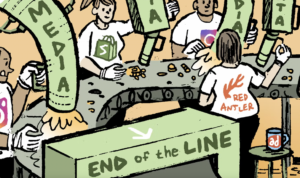
Earlier this year, Idea Peddler partnered with PJX Media, Share Local Media and Locality on a white paper entitled “The Attribution Illusion: Inside the $1 Trillion Crisis Transforming the Future of Digital Advertising.”
The paper, which was written with the help of a New York Times investigative journalist, makes the argument that recent regulatory updates and changing consumer attitudes toward data privacy are wreaking havoc on match rates. This, in turn, causes the ad tech ecosystem to waste billions of dollars on ineffective programmatic inventory, producing poor business outcomes despite rising ROAS numbers.
Cohen spoke with AdExchanger about how marketers should be rethinking their data strategies.
AdExchanger: Can you tell me where the idea to do this research first came from?
CIMIN AHMADI COHEN: I remember the very first campaign we started putting ROAS in. I was like, “This is a slippery slope.” And sure enough, one particular client got really hooked on it. They told me their CEO said, “Make this number go up every year, and no matter what happens in macroeconomic conditions or specific industry conditions, focus on just getting this number up.”
So, we did make the number go up the year after that. And then numbers in the business were not good. Our match rates started to fall to the point where we were below double digits, and the addressable audience became so small, which was weird. We were like, “How is this happening?”
Well, GDPR happened so long ago; iOS14 happened so long ago. When California, Texas and Colorado started with privacy legislation, it just didn’t even hit my radar. And when Google stopped the Cookiepocalypse, it kinda felt like we were past all this. But then we saw these issues crop up and thought, okay, maybe these are all interconnected.
Do you think if Google had actually gone through with replacing cookies, we’d be having a different conversation at this point?
I think it would have been a signal to people that we’ve got to solve this problem. And I think people did get pretty far. But the problem is the same whether they’d called it off or kept it going.
As we see this huge displacement of search and no-click traffic to websites through AI, it’s going to just accelerate the issue that you cannot count on cookies. The volume of trackable cookies that come in are so small, and the data is not very well enriched or accurate.
How are you changing your own data strategy to adapt to poor match rates?
It really depends on the client and the part of the funnel that they’re trying to target.
We do very, very little pure programmatic display anymore because it’s just deeply ineffective. It’s not good inventory, and there’s just too much waste and seepage into territories that clients don’t intend.
I don’t have the stats off the top of my head, but the data has been in for 20 years about how much context matters – being in premium, completed-view, living room CTV environments, and actually creating enough attention and memory recall for the brand’s ad to be worth it.
And then, it’s about getting creative about when we bring in first-party data and behavioral data and not thinking that’s going to be the be-all and end-all for our prospecting. It’s not that any kind of targeting is completely false. It’s just that there’s overreliance.
CTV platforms have begun to embrace contextual targeting in recent years, rather than identity-based targeting. Is that something you’re excited by?
For sure. Contextual has been successful in the past, and bringing it back into the fold is great. But I’m cautious about the perception that there are billions of contextually targeted impressions in premium environments that are unbought and unbidded on.
If you’re trying to reach a sports enthusiast with a sports-related beer ad, you need to have a deal with the content owners to secure that inventory. Maybe programmatically you can get a handful of impressions, but there’s also going to be a lot of other random stuff in there.
Is there anything you’re seeing that makes you feel like things are going to change for the better soon, or are we still in crisis mode?
I don’t know about crisis mode. The biggest thing that clients say when we walk them through “The Attribution Illusion” is, “I totally see how that’s taking a lot of credit for things that were already going to happen. But I need a number to take to my board.” It’s hard to fight that.
Things like brand-lift studies and MMMs will start to replace current attribution models, but I don’t think it’s going to be all or nothing. There are still going to be performance lever arms, where finding those audiences and converting them before they pick an alternative product is still going to be important. I just think that people are wising up to the fact that you can’t put all your eggs in that basket.
This interview has been lightly edited and condensed.