
Mobile video will affect the viewer experience and advertiser strategies for the Super Bowl on February 3. According to Adobe, users turn to mobile video twice as often during a major sporting event than a typical day.
Adobe analyzed 1.4 billion mobile video starts during 10 large sporting event days in 2012 as well as on typical days. On a typical day, 8% of sports-related video content on sports, media, and entertainment sites was viewed on mobile devices, jumping to 16% on special event days. Tablets saw 9% of sports-video views on those days, while mobile phones accounted for 7% of views.

Tamara Gaffney, senior manager of Adobe Digital Index, which tracked and analyzed this data, said that tablet penetration is driving a lot of mobile consumption, particularly when it comes to video.

“[The 16%] is significant in terms of traffic, but it’s also significant for advertisers, because we know that mobile viewers, especially of the tablet variety, are more fluent and they spend more,” she told AdExchanger. “There is a lot of opportunity to specialize in inserting ads into mobile video content on certain special sports days. And for advertisers who maybe couldn’t afford the $3.8 mil for 30 seconds, there’s an opportunity still.” More on the Adobe Digital Marketing Blog.
According to Nielsen, the average cost of a 30-second Super Bowl ad has been rising since 2009, with a slight dip 2010. For 2012, the average price of a 30-second spot was $3.44 million.
While marketers and advertisers try to supplement (or replace) their Super Bowl spend with social media and digital outreach, 36% of people who plan to watch the Super Bowl this year said they expect to use a second screen to complement the on-air action, according to data from real estate company Century 21. This second-screen activity will include mobile video viewing, as well as going to advertisers’ websites and social media pages.
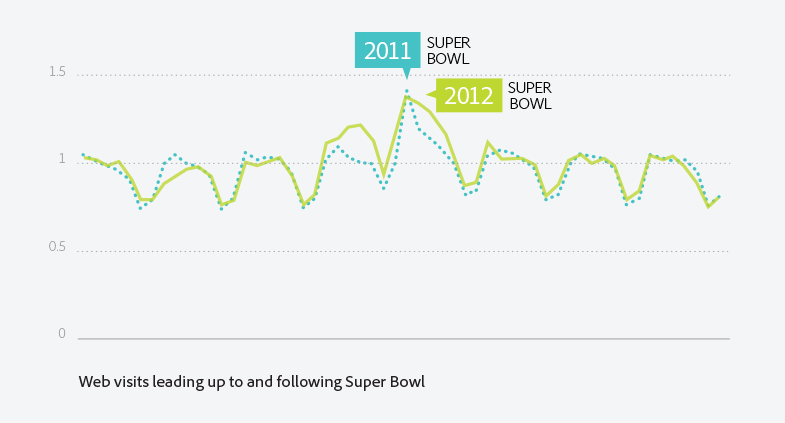
Adobe also analyzed how having a commercial air during the Super Bowl affects website traffic. On the day of the game, website traffic for brands that advertise during the Super Bowl is expected to be up 20%, with higher-than-average traffic for the week following the game, Adobe reports. After that, however, the number of visits and page views returns to normal.
However, looking at 2012 data from the Super Bowl, when many advertisers released or teased their ads online prior to the game, traffic was more spread out. Website views and visitors peaked earlier in the cycle in 2012 compared to 2011, and traffic after the Super Bowl was still up compared to average days, but the increase was smaller than it had been in 2011.
Data from YouTube, however, shows the positives of releasing part or all of a commercial early. Mashable reported that, based on YouTube data, companies that introduced their ads on the video site prior to the big game in 2012 saw an average of 9 million views. The companies that kept the ads secret saw 1.3 million views.
“We saw that the post-Super Bowl bump was not as strong in 2012 as it was in 2011,” Gaffney said. “Did we just pull forward the same number of website visits we were going to get? Or did we elongate the whole thing? That’s where marketers are probably going to do more this year: a post-campaign, as well as a pre-campaign.”






