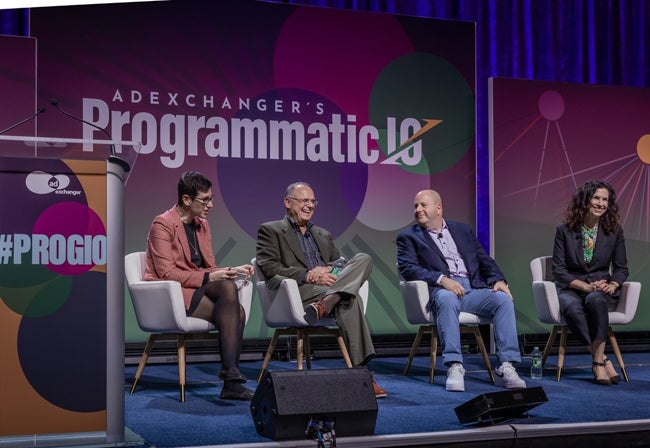
The CEOs of the three largest advertising trade orgs – IAB, ANA and 4A’s – agree that we need a federal privacy law. They just don’t agree on exactly how to get there.
But it appears as if they’ve buried the hatchet after their public squabble earlier this year, as the trio shared the stage at AdExchanger’s Programmatic I/O in New York City on Tuesday.
A quick refresh ICYMI: IAB CEO David Cohen gave a provocative speech in January about “extremists” attacking the ad industry in the name of privacy, referring to lawmakers and allegedly anticompetitive companies like Apple. The ANA and 4A’s then issued a joint statement opposing Cohen’s divisive language.

At this point, though, the urgency for a national privacy law calls for a united front. The absence of a federal regulation poses a potential “national crisis” in terms of consumer protection and trust in the advertising industry, said Bob Liodice, CEO of the ANA.
Although, the ANA, 4A’s and IAB will stick to their own preferred flavors of lobbying.
“There are different ways to go about it,” said Marla Kaplowitz, CEO of the 4A’s. “[We] agree to disagree.”
Finding the right approach
Still, influencing privacy legislation requires making some noise. It’s just a matter of what kind of noise.
Accusing lawmakers and large tech platforms of “extremism” and “hypocrisy” is certainly one way to get their attention.
Cohen doesn’t necessarily intend to change his tune from his January speech. In fact, he said, the “temperature” of conversations about a national privacy law “is not hot enough.”
Cohen said that his impassioned speech “got a lot of reaction,” resulting in meetings with both Apple and FTC Commissioner Rebecca Slaughter, who presented at the IAB’s public policy and legal summit in DC earlier this year.
But “reaction” doesn’t always translate into progress.
That’s why the ANA and 4A’s believe in taking a more diplomatic tone to advocate for a national privacy law.
“In Washington,” Liodice said, “you need to make friends and win people over” by staying cordial. When relationships are disturbed, he added, a lot of ground is lost.
The state of privacy
Yet the reality remains that the US is now home to a dozen state privacy laws – and counting.
Although these state laws may help ensure some level of protection for consumers while a federal law is still pending, a patchwork of privacy statutes could actually be doing more harm than good. It’s hard enough for consumers to understand long-winded privacy policies online, but without consistent legal standards, it’s nearly impossible.
“Consumers think we don’t do a good enough job as an industry telling them what their data is being used for,” Cohen said.
Advertisers are grappling with the volume of state privacy laws, too. “Compliance costs alone will hinder the industry,” Cohen added.
Small businesses especially are struggling to fund the tech and teams necessary to comply with 12 different laws.
“That’s why we’re lobbying like crazy to get federal legislation [passed],” Liodice said. All these different state laws are “not helpful” for consumers, he added, and “Congress is not living up to its responsibilities” to protect consumer privacy.
But it’ll take quite a bit more time to pass a federal law after the proposed American Data Privacy Protection Act hit a wall in Congress last year.
How long exactly? The onstage consensus was at least another four years, although Liodice shared optimism for 2025.
Only time will tell whether lobbying – regardless of the flavor – can help expedite the process.