

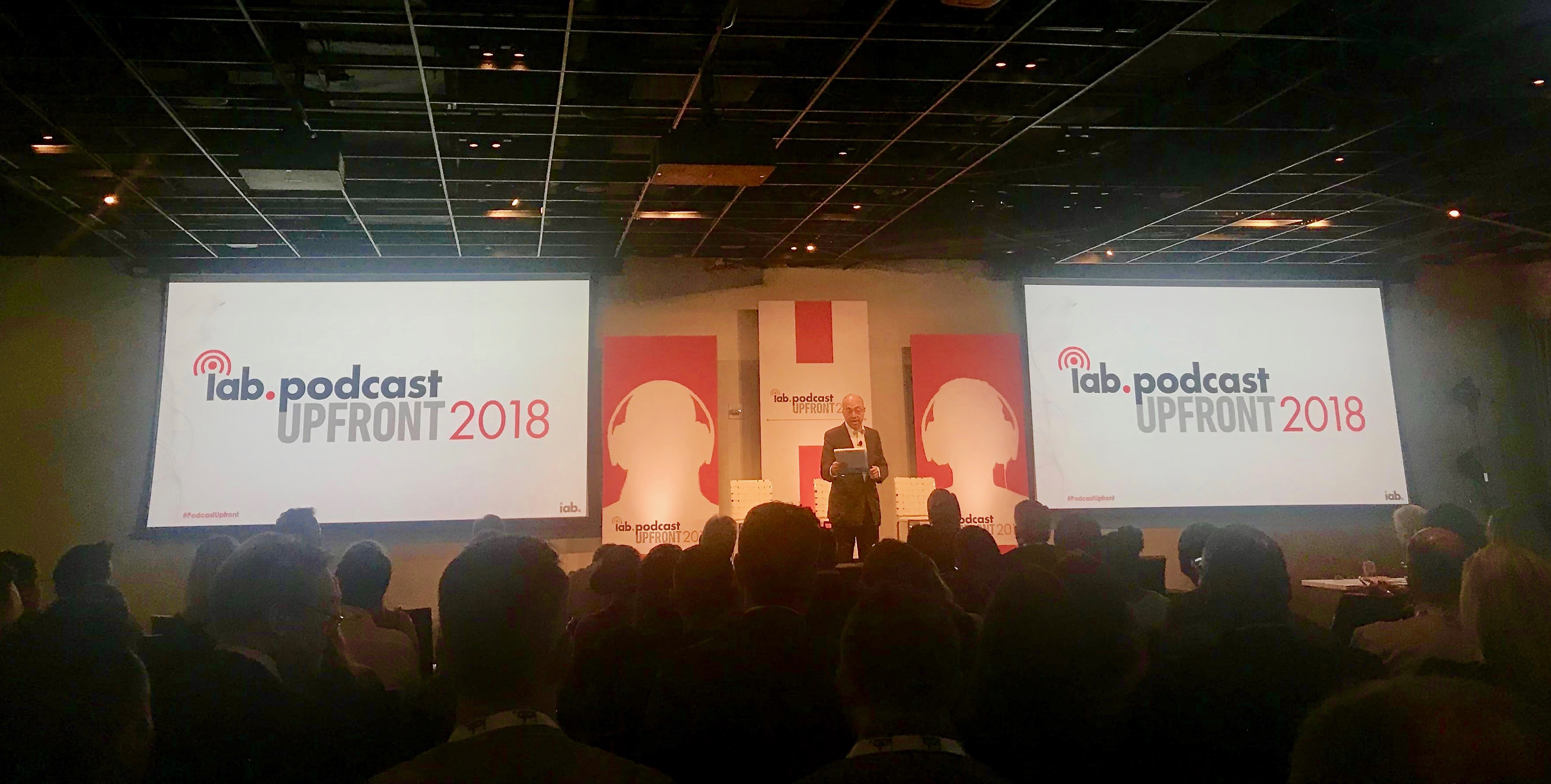
If there’s one takeaway from the IAB’s fourth annual Podcast Upfront in New York City on Thursday, it’s that richer measurement has made podcast advertising more enticing to ad buyers.
This year, Apple and Spotify began sharing more granular analytics with publishers, and the IAB released the 2.0 spec of its podcast measurement technical guidelines.
“This will be the year of data,” said Hernan Lopez, CEO of podcast network Wondery. “As the industry is leveling, clients want more and more data and we need to respond.”
It used to be difficult for podcast producers to know who engaged with their shows after the point of download due to a lack of data from player apps. Now, buyers have tangible proof that listeners are engaged – which is why the podcast ad market is poised to hit $402 million this year, according to Panoply.
Buyers can now know, for example, that 85% of listeners to NPR shows would rather listen to an ad than pay for a commercial-free app, said Gina Garrubbo, president and CEO of National Public Media, NPR’s sponsorship arm. And 90% of listeners of HowStuffWorks’ podcasts listen to an entire ad, with 70% reporting they enjoyed and paid attention to it.
“As we started looking at Apple analytics, 85% of our listeners are not just fans, they’re super fans that subscribe to our shows,” said Conal Byrne, president of HowStuffWorks.

With more data, some networks are building tools to offer better targeting across their shows. Wondery revealed a product onstage that retargets podcast listeners with display ads on desktop and mobile, as well as an attribution tool that lets advertisers cookie their sites and match them to a cross-device listener database.
Better targeting can also give buyers more opportunities to reach their audiences on podcasts. HowStuffWorks uses dynamic insertion on all 10,000 episodes in its archives to monetize its back catalogues with up-to-date ads.
“We can target whatever audience you want, on whatever day you want, on whatever show you want, across our entire catalog,” Byrne said. “That means less ad waste; you’re talking to more people you want to be talking to all the time.”
Panoply talked up Megaphone Targeted Marketplace (MTM), its podcast network that uses Nielsen data to let brands target audiences on more than 500 shows. MTM has 140 million downloads per month and 5 billion annual impressions, and buyers can use its listener ID to retarget listeners on digital.
“Targeting works in this space,” said Matt Turck, chief revenue officer at Panoply. “Now agencies can build podcasting into robust, smart media plans.”
Other publishers are using data to increase scale. Market Enginuity, the sales arm for PRX, uses audience data to bundle different shows with the same audience.
“Data allows us to look deeper within our tribes and cross-tribes for similarities,” said Sarah van Mosel, chief podcast sales and strategy officer at Market Enginuity.
Lingering doubts
Despite advancements in podcast media buying, sellers are cautious about disrupting the listener experience. Wondery, for example, won’t target users within a podcast environment.
“Consumers see podcasts as an oasis in the jungle of digital media,” Lopez said. “We’re going to be careful about how we roll out these solutions because we know listeners are particularly sensitive about how their data is used.”
For the most part, buyers are OK with less granularity on their podcast buys than other digital buys. Many are just happy to see scale. Podcasts at the upfront touted audiences in the 10 million to 20 million monthly download range. Big brands like 1-800-Flowers, Quip, Away and Harry’s attended the event, and major networks like ESPN and Univision presented.
Hemali Lakhani, VP of strategy at health care agency Underscore Marketing, said she’s more likely to recommend podcasts to clients now that the medium feels more mature and scaled.
“It’s more clear that the industry is advancing, so I feel more comfortable recommending a sponsorship for clients,” she said. “I love the storytelling, and it’s getting more diverse.”
For most buyers, granular targeting and data are “not yet a factor” in their decision to buy a podcast sponsorship, said Charles Dannison, senior account executive for agency partnerships at WNYC.
“As of now, it truly is about the audience that each show brings,” Dannison said. “When you slice an audience so thin, you really lose the focus of the story.”






