

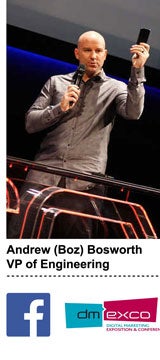
 Facebook engineering director Andrew Bosworth informed marketers that “mobile is the ultimate branding device” and that “brands are more important than ever before” as he kicked off day two of the Dmexco conference today in Germany.
In his opening keynote, Bosworth drew a comparison between 19th-century travelers, who had very little information about the places they visited and relied on familiar brands, versus the present, when people are awash in information.
“When I get off that train and I pull my phone out, I am no longer just choosing the bars on a city block, I am choosing bars from all over the city,” Bosworth said. “These devices process so much information that it is a real challenge to navigate. So if in the past brands existed to help navigate a world with too little information, then in the future brands will exist to help us navigate a world with far too much.”
Approximately 1.2 billion people are on Facebook and 470 million of those people use the social network’s mobile site every day, according to Bosworth. When he joined Facebook seven years ago, his first project was to build the News Feed to help users sort through the overwhelming amount of information that was already on the site.
The News Feed is “a marketplace for attention” that lets people “use signals to sort through vast amounts of information,” Bosworth said. Brands need to create compelling content since they are competing with a user’s friends and relatives for attention on the News Feed, he added.

“Focus on relevance,” Bosworth advised. “Marketers often want to stand out from the crowd but people are … more connected than ever before so what you do has to be part of the context of their lives. Ask yourself, how can you be part of the crowd?”
Bosworth also urged marketers to focus on mobile-first campaigns. “Mobile is not the next big thing,” he maintained. “It is the present and if you aren’t planning all your campaigns as being mobile-first you’re missing the point. Mobile is about your core reach.”
Bosworth’s remarks came on the same day Facebook unveiled a new effectiveness tracking tool for telecom marketers. The Telco Outcome Measurement tool is designed to help telecommunications companies including carriers and operators draw connections between in-store sales and ad impressions on Facebook.
The tool analyzes Facebook’s impact on sales using “aggregate and anonymous information about devices, operating systems and carriers,” according to a blog post.
“From this starting point, we can establish test and control groups to determine how and when an ad on Facebook correlates to certain actions, such as a group of people switching to new handsets, tablets or carriers,” Facebook explained in the post.
The Telco tool has shown that telecom ads delivered in the News Feed on desktop PCs are seven times more effective than right-hand-side ads, and that ads delivered on mobile are nine times more effective than ads on a desktop PC.
The Telco Outcome Measurement tool is available in nine countries, including the United States, and will be rolled out to more countries later this year, according to Facebook.









