

 Besides its analytics announcement, Salesforce.com turned up the volume on mobility and its future in the wearables market during the Dreamforce conference.
As if on cue, rapper Will.i.am paraded onstage Wednesday evening with a group of engineers where he revealed “PULS,” a smart wrist band he developed via fashion and technology firm i.am+, a business he runs in between tours. (Salesforce Ventures is an investor in i.am+, a spokesman says.)
What does this have to do with Salesforce.com from a business standpoint? Very little, though it underscores the CRM giant’s focus on mobile development. The company rolled out “mobile-first” platform Salesforce1 last year and followed it up this year with app developer tool Salesforce1 Lightning.
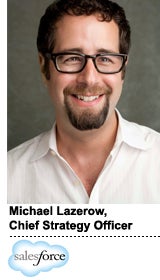
Michael Lazerow, chief strategy officer for the Salesforce.com Marketing Cloud, said the company builds in an “API-first” manner, and that many platforms were subsequently rewritten to account for this mobile shift.
He spoke with AdExchanger about the company’s mobile efforts, the recent rebrand of the Marketing Cloud, and the integration status of various Marketing Cloud components.
AdExchanger: First, why did you lose the ExactTarget name?
MIKE LAZEROW: It was strategic. We came to a realization that we had spent two years replatforming a social product. It’s always been doing well, but it wasn’t one product.

A lot of big companies are running social through us. Some are using Buddy Media or some were using Radian6, but now it’s Social Studio, a new product.
The more we looked at ExactTarget, the more we realized social is an important part of the customer journey and this concept of unified view of a customer, and pushing them along in the journey was really important. Part of that journey is using a mobile app or calling customer service. So as a company we thought it was important to build one customer engagement platform and marketing should be just as important as sales and service. Just like there weren’t subbrands of our Sales and Service Clouds, we thought there shouldn’t be a subbrand for Salesforce.com Marketing Cloud.
Can you discuss some of your recent executive exits? Namely, ExactTarget cofounder Scott Dorsey and Peter Goodman from Social.com.
Scott Dorsey is an incredible executive and he set us up for success. He built a fantastic business over 14 years and took it public. Scott McCorkle was the president, product head and led the vision. I’m excited about that business. In many ways, it’s not just Marketing Cloud. Salesforce.com’s customer platform starts with marketing.
You’ve scored some new customers, including McDonald’s.
They were a company that was using a lot of different technologies and this was the first time they went all in with one. They entered into a very large transaction with us to power this platform approach. [It included] a unified view of a customer at global scale with the ability to deploy content locally and through mobile. It was new for them to centralize like that and we have seen moves from a lot of guys like Microsoft to standardize on us.
What is Microsoft standardizing on?
Microsoft is primarily using Journey Builder. … We believe Salesforce.com products integrated with Microsoft products makes sense and I assume we’ll do more of them.
What about Live Nation? They talked about using Salesforce.com Marketing Cloud, but don’t they use Adobe Analytics (previously SiteCatalyst), too?
We’re seeing companies use many solutions for traditional, cookie-based analytics. We now have some of that data available natively [through Web analytics we launched at ExactTarget Connections in Indiana] and Live Nation has said they’ll use these tools as point solutions, but they run their business on Salesforce.com Marketing Cloud. Their business is predictive analysis, emails, mobile apps, texts, in-app messaging and they’re undergoing a change in their industry where they’re not just a ticketing agency. They’re responsible for music discovery in many cases and what happens before you go to the show and after the show. Every piece of that is mapped out in Journey Builder. They map out that next best offer with our product.
So let me get this right – Salesforce.com offers Web analytics apart from your new Analytics Cloud? What’s the difference?
It’s more than traditional analytics because in many ways, we deploy the message (and the metadata from that message) so when you show up to a website powered by our [Marketing Cloud] technology, it’s personalized as if it’s an email or mobile message. It’s native to our platform.
Salesforce.com just rolled out Lightning, a mobile app development platform. How does this work for marketers?
Lightning has three primary components. It’s easy to build mobile apps, [so] you don’t need to be a programmer. There are common interfaces, so if you want to collect information, program sales interfaces, do drag and drop, or build custom data into an app, you can.
There are advanced filters where you can dive into your data. We’re seeing big use cases around SharePoint integrations, so a lot of companies want to pull in content libraries from their own systems.
There is live data you can drill in to any way you want. It’s really a new vision for the industry that it shouldn’t be hard to implement mobile apps really fast.
What about mobile analytics?
Getting the traditional analytics systems to work in mobile apps is hard. That’s why you have these young companies like Appboy, which I’ve invested in, and others, who are doing mobile-specific ad stacks and that’s an exciting space for the future because we still don’t know what the ad stack of mobile will look like. Journey Builder for apps is marketing automation inside of apps. How you get people to download is important, but how do you incent people to come back and retain them? Marketing automation in mobile apps will be huge.
Are you challenged with integrating all of these new platforms?
Two years ago when we didn’t have common Salesforce1 or Lightning or data APIs, it was hard. But the apps we’re building today, we’re building with the same APIs we’re giving developers. Some technologies may have SQL servers, some may use Oracle databases, some may be Javascript, but it doesn’t matter because we’ve worked out the common APIs. I was never told when I started to rewrite Buddy Media with this technology, but we all worked together to figure out how do we expose APIs.
Facebook VP of advertising and global operations David Fischer announced Custom Audiences during Dreamforce 2012. What do you think of the new Atlas and Facebook’s cross-device ID?
We love it because when we think of customer journeys, we don’t just think of email. We now have Journey Builder for Apps. We’re now thinking: “Who’s this person and let’s not just hit them over the head with retargeting.” We’re spending a lot of time figuring out: “What if you add your paid marketing to your customer journeys?”
What about Google’s development of an ad ID?
That’s different … We’re very aligned with Facebook, because when you communicate with people based on who they are, it turns into better advertising – less waste, more effectiveness. We are a store of our customers’ data. Facebook has the world’s customer information and they know who you are because you’ve given that to them. When you combine that, you’ve moved past cookies and Web pages to people and conversations in a very powerful way.
Google is both media company, ad server, measurer and so it’s hard to imagine a day in which companies are going to be putting all their CRM data into Google because Google uses data to sell ads. We don’t sell ads. We will help you optimize your ads. You buy with Facebook and we’ll help you make them effective. The same with Twitter, LinkedIn and YouTube, as a partner, has been great. I think Facebook’s getting it right by putting people at the center of their ad strategy.
Scott McCorkle, ExactTarget’s CEO, seemed content with social advertising when asked about Salesforce.com’s paid media strategy, but said broader use cases are of interest. Will you buy a DMP or DSP?
We don’t comment on M&A. What we have said publicly is we are going to acquire. We’re going to build. We’re going to integrate. We haven’t changed our playbook. Pardot was a great acquisition for (ExactTarget) and (iGoDigital) was a great acquisition for them. We’re trying to be really clear to the marketplace that if it touches a customer we want to be your partner to make it a great experience.







