

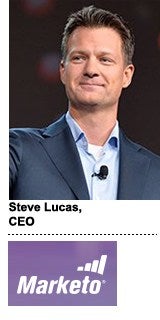
 In his second week as Marketo’s CEO, Steve Lucas walked away from his first board meeting with a mandate from investors to hire 50 developers, add 100 more salespeople and to “go fast.”
Marketo’s first order of business was to re-engineer its marketing automation software from the ground up – a continuing overhaul that includes adding account-based targeting, which Demandbase and LinkedIn had already tackled – and deeper data management and analytics.
“You’re going to absolutely see us go after these marketing clouds where there’s really no integration,” said Lucas, who replaced longtime Marketo CEO Phil Fernandez in late October. Lucas came to Marketo from SAP, where he served as global president of the German software giant’s multibillion-dollar platform and applications businesses.
Lucas also seeks to shake up Marketo’s image as primarily an SMB solution for automating email lists.
“Microsoft and Tesla use our engagement platform as their global digital marketing hub,” he said. “Out of our 5,000-plus customers, well over 1,000 of them are enterprise customers and we remodeled our entire field sales organization so they can be more focused on the enterprise.”
Lucas spoke with AdExchanger about his move to Marketo and how the company is competing with big marketing clouds.
AdExchanger: How are your first few months on the job going?
STEVE LUCAS: It’s so much more fast-paced than SAP. Marketo is a much smaller company so the pace of innovation moves a lot more rapidly. I really underappreciated the significance of their partner community when I first joined.
I found out there are over 600 third-party ISVs (independent software vendors) that integrate with and extend Marketo. And we’re closing in on 100,000 members of our online community, Marketing Nation.

How is the technology doing?
We are expanding Marketo from a marketing automation tool to an engagement platform for enterprise organizations. And there’s a huge fundamental difference between the two. We’ve been at work on the technology for about two years, but are really making that pivot now.
Our goal is not to build every application a marketer needs, but to facilitate a platform that can integrate any application the marketer needs through a robust API to 600 partners. All of our own marketing applications, whether it’s lead management, campaign management, account-based marketing or web personalization, they’re all completely integrated within a single platform.
How is what you’re doing different than other marketing clouds?
First of all, everybody is in the cloud, so we didn’t set out with the purpose of building a marketing cloud. I think the keys to Marketo’s success will be staying true to the vision of building an integrated engagement platform and not get stuck on this notion of buying until you end up with a mishmash of unintegrated solutions.
We will make acquisitions and will consider a few right now, but they have to be the right fit, plug into our technology and my No. 1 benchmark is, does this help the marketer win?
You were global president of platforms and applications at SAP. How are they doing in mar tech compared to the rest of the enterprise pack?
They’re a big company with deep pockets and I have nothing but fondness for SAP, where I spent the best seven years of my career barring the past three months.
SAP has significantly more work to do on their marketing cloud in order to be competitive with an Oracle, etc., but I really believe Marketo is profoundly well positioned to compete with and win mind share with the marketer versus Oracle and Salesforce.
Do you expect this race to acquire marketing and ad tech to continue?
I think acquisitions and the consolidation will continue because the marketing landscape is ridiculously crowded. But I don’t see it where Oracle and Salesforce will be all things to all marketers. What we’re seeing with all of the consolidation is this “cloud lock-in.” They want you to use more of their products. They have interest in selling the marketer a tool that obligates them to use their CRM.
So what’s Marketo’s objective?
Our objective continues to be, No. 1, let’s define a really strong vision for the marketer. … We’re doing away with the days of the gated whitepaper where you have to go to a website and input all your information. Those days are tired. The engagement economy is all about the buyer expectation. They want to know your brand or company aligns to their values, whether they’re corporate buyers or a consumer.
How do you make marketing automation more engaging?
We have to move into things like personalized video content or when you’re Googling a relatively generic term like “truck,” maybe we take Ford’s customer data – demographic and browsing information – and make that ad so hyperspecific because we have access to this digital persona. And we can customize that content automatically through our predictive engine so a marketer doesn’t have to do it all manually.
How is it being owned by a private equity firm?
It’s changed the trajectory of the company in a very positive way. Being wholly owned by a private equity firm let us make investments for growth. The top two mandates were driving growth and innovation for the marketer. I’ve seen nothing but significant investment in Marketo and growth in our marketing, sales and development budget since I’ve been here.
Interview has been edited and condensed for clarity and flow.







