

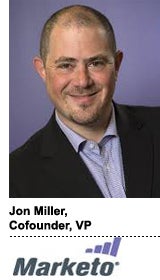
 Marketo posted strong Q3 earnings last quarter, recording revenue of $25.5 million – a 65% increase year-over-year. The company remains independent today, despite a spate of marketing automation acquisitions in recent years: Teradata bought Aprimo, ExactTarget bought Pardot, Oracle bought Eloqua and Adobe bought Neolane. Many analysts predicted Oracle’s rival Salesforce.com would purchase Marketo, but the company ended up acquiring ExactTarget for $2.5 billion last summer.
Jon Miller, Marketo’s cofounder and VP of marketing content and strategy, sat down with AdExchanger during Salesforce.com’s Dreamforce to talk about Marketo’s future moves.
AdExchanger: After Oracle scooped up Eloqua, many predicted Salesforce.com might make a move to acquire Marketo. Was this ever a possibility?
JON MILLER: A lot of people thought that, but Salesforce.com very clearly wanted to make a play that [could be perceived as] taking them closer to the B2C side of things. The interesting thing about Salesforce.com, and I read an analysis about this the other day, is they’re growing at about 30% year-over-year and currently have about 40% market share. But the CRM market is only growing at about 8% per year.

So, the analysis found if they keep growing 30% year-over-year, they will have 100% of the market by 2016 at which point… you can’t grow any faster than the market is growing. Their valuation today doesn’t support growing at only 8% per year, so it is imperative for Salesforce.com to get out of being just CRM. I think they saw — and I’m not saying this is true and these are only my words — Marketo as probably more in the space that they’re currently in and not where they wanted to go.
Shortly after your IPO last spring, Salesforce.com acquired ExactTarget. What’s your view of the marketing automation landscape as it stands today?
We’re a marketing-first company. To us, marketing-first means a lot of different things, but it mostly means we think about marketing all day long. Marketing-first means you don’t have your CRM system first and then you think about adding in some marketing. Marketing isn’t subservient to sales.
I believe passionately that marketers want to buy marketing solutions from marketing companies. At Epiphany [a CRM provider that has since become Infor], where [current Marketo CEO] Phil Fernandez, [current Marketo CTO] Dave Morandi and I came from before we founded Marketo, we started out as a marketing-only company and frankly, we lost our way. We tried to go in and say, ‘Well, we want to sell seat-based solutions’ and so we acquired an SFA [sales force automation] company, a call center company. We weren’t marketing-first anymore and companies like Unica and Aprimo were able to step in and fill that void. [We recognized that] marketing isn’t a second-class citizen to CRM.
How are you developing your platform now?
We are focused on defining what it means to be the digital marketing platform of the future. Since we started Marketo seven years ago, we’ve had a vision of what that looks like. I think if we can do that, we’ll just be extending our gap through innovation while everyone else is thinking about integration. The IPO gives us more resources to go do that.
Marketing automation is no longer confined to email. How are solutions architected today to account for multi-channel?
If you think about what marketing automation should be, there are a couple of key pieces. The first is building the marketing database of record, so we’ll sync contact information from CRM, but we’ll augment that with all of this rich behavioral data – what emails are you opening and clicking, what Web pages are you visiting. The first piece of where that’s all going is [bringing] in more types of information to build that rich behavioral database.
We added social functionality two years ago, so now we can augment our view with, ‘What content do you share?’ And I think mobile devices are an incredible source of context because you know where somebody is.
How important is location data for marketing automation?
I don’t think that’ll necessarily apply across all industries. I sell software and 99% of the time, I don’t care where you are. Now, if I know you just walked into the exhibit hall at Dreamforce and I know you’re a customer, very well I might say, ‘Hey, thanks for being a customer. Come by our booth for a free coffee.’
The real point is, marketing automation wants to have more and more inputs of data to form that behavioral marketing system.
How are you tackling the “big data” problem that stems from all of these inputs?
I’m one of those people who squirms when I hear big data, but if you really embrace all of this contextual data that’s coming in, you do reach the point where you can’t query those databases using SQL. Over the last year, Marketo has rearchitected our entire back-end using Solr, which is a big data technology that lets you do queries on this massive amount of data in a very high-performance way.
That’s an example of how we’re innovating and that becomes more and more important as you get more and more context. Now, on top of that, you have more and more data that lets you get better at predicting what is the right thing to do, the right offer. We’re investing in what I effectively call ‘the brain’ – we’ve got all this data, now how is the marketer going to map out, ‘What are the experiences you should have?’ and predict the next-best offer.
The last piece is, you’ve got to interact with the customers in a targeted, personalized way over more and more channels. Marketing automation has long been associated with email and it really is a better way to send email instead of doing these big batch campaigns, but I don’t think people wake up and say, ‘Boy, I hope I get an email blast today.’ They want a relevant conversation and having that rich access to behavioral data is the secret sauce to better, engaging emails.
Someone at Salesforce.com called email the “workhorse” of digital marketing. Do you agree?
I say it’s the glue. You can’t sign up for a social account without an email address and when your social network wants to notify you that something really important has happened, they send you an email. So email is not going away, but the days of the big batch campaign are. We increasingly have customers that are using Marketo to, similarly to how you send an email, define ‘What is the push notification somebody is going to be getting?’ At the end of the day, its another opt-in channel that people have with them all the time [because of mobile.]
I’m really excited around the area of Web personalization…A [a lot of the time when] you’re pushing a message to somebody, you’re pushing it out over email or push [notification], but you also should continue that conversation when they come to your website.
A lot of B2B platforms are bulking up on retargeting. What’s your position as the lines continue to blur between online advertising and marketing automation?
That’s where an integration with one of our partners, Bizo, comes in. If I don’t go to your website, but I go to ESPN.com, Bizo can say, ‘Hey, Marketo, what offers is [this person] supposed to see?’ Absolutely retargeting becomes another channel in this personalized experience. I’m not saying we’re doing all of this yet, today, but when I say we’re innovating for the marketer, we have this solid vision for ‘more data in,’ being the brain and then having more ways to have personalized, relevant interactions with customers over time. I personally feel that’s very concrete.







