Viacom on Monday formed a multi-year agreement with Comcast’s advanced ads business, FreeWheel, to expand its use of the tech platform.
Previously, Viacom used FreeWheel to power digital ad decisioning, but now, it will also use FreeWheel’s operating system to manage yield and grow revenue across live TV, set-top box and video-on-demand inventory.
In addition, it’s using Comcast anonymized set-top box data to improve precision in addressable TV targeting.
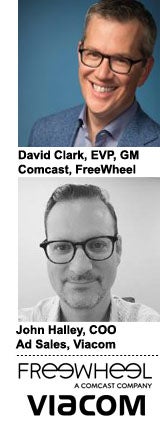
“As we looked at our own business, which is about reaching highly engaged audiences viewing long-form content across a variety of screens, we wanted the ability [to monetize them] everywhere, whether it was on-demand or live TV,” said John Halley, COO of ad sales for Viacom. “This is an alignment around the vision of the future of the TV ecosystem.”
FreeWheel will integrate with and power Viacom’s data platform, Viacom Vantage.
FreeWheel originated as a broadcast ad server but, since its acquisition by Comcast in 2014, is now the umbrella brand for Comcast’s advanced advertising business.
It encompasses Comcast’s many video acquisitions, including the addressable platform Visible World, media selling software Strata and yield management platform StickyAds.

“The vision we see from a lot of heads of sales and CFOs right now is, the faster they can get to that ability to run one campaign across their entire portfolio of assets, the better,” said David Clark, EVP and GM of FreeWheel.
“Meaning, you need a solution that works in all three environments, including linear, set-top box and VOD. Then, you also need a data strategy built on top of actual viewing data.”
Comcast’s set-top box data, which is now powering custom segments for TV consortium OpenAP, is a competitive differentiator for FreeWheel in its competition with Google’s DoubleClick.
Google has reportedly emerged as a stiff competitor to FreeWheel in a bid for TV publishers’ ad delivery business.
“You need a data strategy built on actual viewing data and that is our strength – it’s a quality play, and we continue to win on that,” Clark said. “A lot of people look at how the digital world played out and are concerned about that happening in TV. … This isn’t just an engineering problem. It’s a business model problem.”
Comcast’s argument is that it knows how to help media and entertainment companies monetize more effectively because FreeWheel has worked on category-specific problems – such as dynamic ad-serving into live environments – for about a decade.
“People in our organization just understand television, and believe that there’s growth in the TV industry, particularly if you can yield manage,” Clark said.