

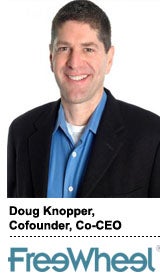
 FreeWheel, a technology and services company cofounded seven years ago by Jonathan Heller, Doug Knopper and Diane Yu, helps media companies like NBCUniversal and Viacom connect TV buyers with premium digital video inventory. It also worked with Amazon to help power video ad content for the ecommerce giant.
Knopper, who also serves as FreeWheel’s co-CEO, spoke with AdExchanger about the deal and delved into FreeWheel’s recent work with Nielsen and AOL around TV-to-online video measurement advances.
AdExchanger: Can you bring us up to speed on FreeWheel?
DOUG KNOPPER: We are focused on the sell side, so we provide the tools and technology systems to help companies like ABC and ESPN do what they need to do to create and sell . Ultimately, that information gets to the brand advertisers and certainly to their agencies, but our primary relationship is not with the brand agencies. We’re very much focused on the concept of brand advertising vs. the concept of direct response. We added a couple of years ago advisory services that’s a growing part of our business. About a year ago we announced FourFronts, which is a private marketplace that allows for buyers and sellers to be able to manage their premium advertising inventory.

You announced a partnership with Amazon last week around its video ad units. What can you tell us about that?
There is not much I can talk about beyond that, but Amazon is working very hard to create a video advertising platform. They are different from many of our television-oriented customers in that a TV company like an ESPN or FOX or Viacom [whose] primary revenue source is making money from advertising. That is not the primary focus of Amazon’s business model, which is commerce and to sell things to consumers. The way they look at it is: How can they use video as part of their offering to deepen their relationship with customers and to get them to buy more? There are certain elements that are different in that we’re working with them [to add], different kinds of ecommerce hooks into it. But for the most part we are helping Amazon deepen their relationship with their consumers and find ways to create a video offering and increase their ecommerce sales at the same time.
AOL CEO Tim Armstrong said 2013 was the year “people and piping” came together to facilitate TV-like measurement for online video. How have you been working with AOL?
We do have a great and close relationship with AOL as a customer and partner. When we announced FourFronts, they were one of the ones we worked with. At its core, it provides the opportunities to make balances in supply and demand come together. If I’m somebody who’s oversold or I’m somebody who’s undersold, you can create a connection in a full and transparent way consistent with the practices and standards to be able to help them manage those imbalances. Maybe somebody has a great sales force and can sell all of the inventory they can possibly get. Maybe somebody can use a little more inventory or isn’t doing as good a job selling to be able to manage that imbalance for the benefit of both parties – that’s something that’s vitally important to this industry and done in a way that’s consistent with all of the established processes and practices and standards of the television world. There’s also another reason at the root of [the private marketplace] FourFronts – there is a lot of benefit toward being able to combine linear television advertising with digital.
What are some of the benefits?
Being able to put those together into a single ad buy and insertion order is really something that’s really important and desired by the advertising industry, especially linear television buyers. Mediaocean is somebody that on the buy side of things, working with advertising agencies, has done a great job managing all of the linear advertising buys. When you connect them with our system in managing the digital side of the house, you really can allow the advertising dollars to flow in one direction or the other. Somebody that wants to make both a combined linear and television buy – and entering that all into the system and letting it flow into its logical places, for us on the digital and mobile side of the house is putting the infrastructure and plumbing into place.
How are you thinking about measurement?
We announced a feature set late last year called Ratings Based Planning. This was part of our core product that allows our customers who are joint customers with Nielsen’s OCR product to be able to manage and essentially deliver their inventory based on a ratings-based buy and do all the planning and inventory management associated with that. We recently announced something very similar with comScore that allows big television companies using our (Monetization Rights Management) system to be able to incorporate ratings, planning, using either Nielsen or comScore or both into their systems. Being able to manage their (both Nielsen and comScore’s) ratings and metrics are what’s driving a lot of the currency behind this. It’s something our clients have really been clamoring for.
How do you look at cross-device content consumption?
The consumer is always going to use the best available screen to watch what they want to watch. Yes, you have second-screen usage, but for the most part, if you’re watching the Super Bowl and you’re in your living room, you’re going to watch it on the big-screen television. If you’re commuting on the subway, you’re going to watch it on your tablet or mobile device. But at the end of the day, the experience of watching premium video, as we know it as TV shows, the experience won’t be dissimilar. There’s going to be a commercial at the beginning, contained within it and at the end of it. The economics are slightly different when you watch on an on-demand basis as opposed to a simulcast or streaming basis. It also, from my perspective, won’t be dissimilar on [the basis of] an Amazon vs. an ABC vs. DirectTV. They’re all going to use advertising within the shows to make money, but sometimes in different ways.
What’s your headcount and 12-24-month plan?
From a company perspective, we’re venture-backed, and have not disclosed how much money we’ve raised, though we’re well-funded from both a variety of venture investors as well as strategic investors that include Turner Broadcasting, Disney and DirectTV. We’ve grown from zero to 200 people over the last seven years. We’re expanding internationally very aggressively and have a number of customers internationally. We’re investing in our core products to meet our customers’ needs as well as the FourFronts marketplace, and building on the growth the market has and solidifying our position.
Is an IPO or acquisition in your cards?
We are a venture-backed company, so at some point something will happen, whether it’s an IPO or acquisition. I’ve always felt like the way you achieve any of those things is you grow your business and operate as best as you can and that’s what we’re focused on doing. We’re heads-down building our business.







