 It’s a tough road for a stand-alone second-screen app.
Beamly, the social TV network formerly known as Zeebox, would appear well positioned to help publishers engage millennial audiences across all platforms.
Its install base grew from 2 million monthly active users in 2011 to 10.5 million today, and Comcast’s NBCUniversal and Viacom have a joint stake in the company. Beamly also has revenue-sharing agreements in place with programmers like Discovery Communications.
But social TV is a tough nut to crack. Many of Beamly’s category competitors have rebranded, shuttered or been acquired over the years. While Twitter has been actively snapping up social TV platforms like BlueFin Labs, Trendrr and SnappyTV, GetGlue successor TVTag shut down, and Apple acqui-hired second-screen app Matcha.tv.
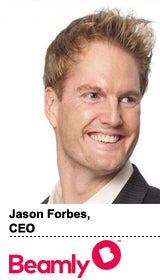
Beamly has hung on by focusing on amplification opportunities across social feeds, according to CEO Jason Forbes
In its earlier iteration, Zeebox let users shape the outcome of a show by voting live during a broadcast.
“These are awesome experiences, but they only work for a tiny subset of all viewership,” said Forbes, a former Time-Warner Cable SVP. “That was Zeebox’s DNA, and others like Shazam do it well, but it wasn’t scalable.”

The time it took to build a custom experience was substantive and often left advertisers unsatisfied.
“We might get a call to action on The Voice saying, ‘Download the free Zeebox app now,’ but as a user, the time it’d take to go to the app store, find, download the app, sign up and get to the show page was exceptionally long and led to a lot of drop-off,” Forbes explained.
During the rebrand to Beamly last year, the dominant gateway to the app became a mobile-responsive web experience where users could interact directly with content (at Beamly.com/The Voice, for example), cutting down on clicks.
Additionally, Beamly stopped focusing on the live experience.

“We found the vast majority of millennials’ engagement occurred before or after the show, not during the show,” Forbes said. With Game of Thrones, for example, “when people are watching that, it’s just a high-intensity drama, and little focus tends to be on the second screen.”
However, Game of Thrones’ programming is perfectly primed for round-the-clock engagement, he said.
As part of its relaunch, Beamly built a content marketing platform for TV networks to turn any TV-related content like articles, videos, gifs and memes into socially discoverable content.
“Most TV networks didn’t understand that while they’re producing awesome TV content, most of that content when consumed by millennials happens on a Facebook timeline, in a tweet stream or in a feed,” Forbes said. “Our secret sauce is taking any type of TV content and repackaging it so it’s more discoverable across Facebook, Twitter, Tumblr or other social sites.”
Because young consumers like variety, they’re not content just watching a rerun of the latest Bravo TV Real Housewives of Beverly Hills episode in their Facebook news feed.
Thus, Beamly is now building a new set of tools for networks that will help them incorporate quizzes, gaming brackets, polls and “Sentimeters” – one-click votes for viewers to see, in real-time, what’s trending with their peers and, more importantly, to interact.
But how do networks measure the success of a quiz on Facebook that’s perhaps packaged with a spot TV ad? Video views are one of the most important metrics to publishers, Forbes said. The second most common metric is page views, which helps them understand the time millennials are spending on their sites after they convert from social or a mobile app, as well as session lengths.
Beamly charges on audience guarantee. For instance, for $100,000, it might guarantee a minimum level of audience around content, which can live on Beamly, social media or any publisher dot-com property. “And we can control and shape discovery around that content, and we provide guarantees around eCPMs or eCPCs,” Forbes said.
Beamly charges additionally for its suite of brackets, quizzes and polls promising publishers ways to help millennials natively discover their content.
“In less than 12 months, we’ve grown 13 times in terms of our monthly audience base,” Forbes said. “The biggest driver has been finding ways to make TV content more discoverable in social for millennials.”