
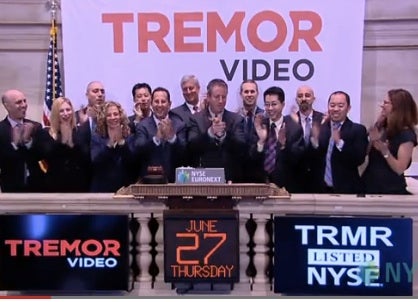
 Tremor Video has officially gone public, giving the company a valuation of $470 million or so based on the latest stock quote and 48.5 million shares outstanding (Amended S-1). In total, the company raised $75 million by selling 7.5 million shares for $10 a piece — below the previous target of $11 to $12 the company had in mind when it originally filed its S-1. Read the release.
Total shares outstanding is 49,439,453, a number that does not include the underwriters’ over-allotment of 1,125,000 shares. The underwriters, Credit Suisse Securities and Jefferies & Co., have within 30 days to decide to purchase those 1.125 million additional shares, which could raise as much an extra $11.3 million for Tremor.
While CEO Bill Day rings the opening bell at the NYSE Thursday morning, the company won’t have much time for a honeymoon with investors. The financial picture painted in last month’s filing was met with a muted reaction from investors and from rivals in the video ad space, some of whom have been testing the IPO waters themselves. In particular, video technology players YuMe and Adap.tv are often mentioned as part of a larger wave of potential IPO candidates. If Tremor’s debut falls flat, investors may frown on those other hopefuls.
While its growth has appeared uneven, the video ad market is poised to reach greater heights and there is ample reason to believe Tremor’s rise isn’t over. However, within the first hour of trading, Tremor, which has its stock symbol as TRMR, was trading down about 2.4% to $9.76 per share. At the end of its first day, the stock was down 15% to close at $8.50 per share.
As the S-1 numbers showed, in 2012 Tremor’s total revenue rose a mere 16%, from $90.3 million to $105.2 million year-over-year. According to numbers from ad holding companies Magna and ZenithOptimedia, global online video advertising rose 20% last year and is expected to do slightly better in 2013.

In part, Tremor’s growth may have stalled as it sought to reduce its reliance on lower-cost in-banner video ads to more brand-friendly, and it hopes, more lucrative, in-stream ads. Revenue from in-stream video ads was up last year by 32.1% to $99.7 million.
In addition, the company is adding more analytics for agencies and marketers via its two-year-old VideoHub business. By keeping that business separate from its publisher-facing ad network, Tremor hopes to avoid the skepticism about conflicting interests that plague other video companies that are trying to set themselves up as end-to-end marketplaces for buyers and sellers, such as BrightRoll, SpotXchange and Adap.tv.
Nevertheless, Tremor is still lagging when it comes to its share of the video market. According to comScore’s May online video rankings, which measures companies’ total number of video ads, minutes, frequency and reach, Tremor comes in eighth, behind BrightRoll, Google/YouTube, LiveRail, Adap.tv, Hulu, Specific Media and TubeMogul. It is ahead of Videology and AOL. Generally speaking, digital video ad spending shows no signs of slowing down, as eMarketer estimates video ad expenditures in the US will rise 41.4% to $4.09 billion in 2013, up from $2.89 billion last year.
Still, given the fanfare that greeted IPOs such as Facebook’s and Groupons, and the resulting disappointment shortly thereafter, by going public with fairly low expectations, the lack of hype surrounding Tremor’s entry into the NYSE may help ease some of the usual pressures that come after the bell signalling the start of trading is rung.








