

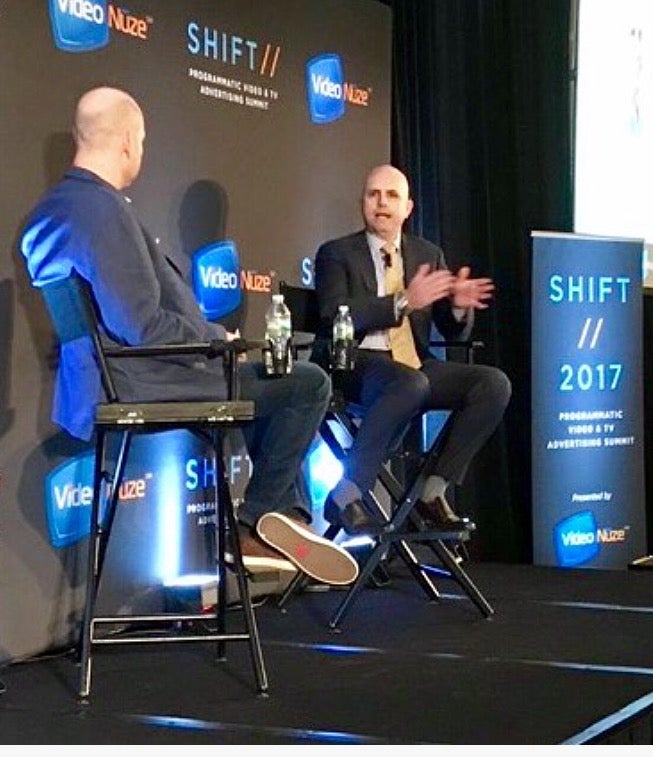
In the words of Jon Stimmel, the chief investment officer for UM Worldwide, planning an over-the-top (OOT) ad campaign is “a Frankenstein of different methodologies mixed together.”
He added, while speaking last week at the Videonuze Shift summit in New York, that buyers need more automation in the OTT planning process: “We are recreating the process every time for individual clients.”
Two years ago, UM began planning and evaluating its mobile, digital video and OTT investments in a converged fashion.
Although every video deal UM does today is “fully integrated,” Stimmel said there’s work to be done to automate cross-screen video buys – and better manage inventory fragmentation across video providers.
Here are some of the key issues complicating OTT planning:
Cross-Platform Audience Measurement
While Nielsen has made advancements in measuring total audience, including in ad-free environments, every streaming video device and platform measures audience differently.

As virtual MVPDs like Hulu Live, DirecTV Now and Sling TV increasingly steal more viewership from traditional cable providers, buyers need more of a standardized view across these emerging OTT environments.
“Nielsen is testing capabilities like ACR through the audience business they bought [with Gracenote], and organizations like CIMM are doing a lot of great work … to quantify what’s viewed where,” Stimmel said, “but unifying that across marketers, agencies and trade groups is important.”
 Inventory Discovery
Agencies want to buy across video environments like OTT and video-on-demand within a single plan, and that’s still complicated because of the sheer number of devices and streaming services.
“In addition to TV content that’s going unmeasured, the ability to search for content within a device or app is hard to do,” Stimmel said. “Consumers today just want to watch the show they like. It doesn’t always matter on what channel, or whether it’s live or on demand. We need to be able to curate content within different environments.”
The good news is that numerous technology acquisitions are helping pave the way for better TV discovery, including Nielsen’s acquisition of Gracenote and Spotify’s acquisition of MightyTV.
Scaled Data
A holy grail for advertisers is buying de-duplicated audiences across multiple OTT apps and MVPD services (such as Comcast’s Xfinity TV Go service) and driving incremental reach.
Yet, one of the biggest challenges with the OTT environment is its lack of scale, caused in part by the many miniature walled gardens emerging in the OTT ecosystem.
To get around the blind spots when measuring OTT, UM taps data aggregators, such as Samba TV, which its parent company IPG invested in, to help fill in the gaps using IP-based or device-level data.
It also relies on partnerships with platforms like Roku, which its sister investment arm Magna did, to verify audience across publishers by matching first-party segments against Roku’s own audience data.
Other providers, such as One2one Media, aggregate and unify disparate MVPD data to help match with advertisers’ first-party records.
Although individual OTT publishers (like Hulu or SlingTV) provide detailed metrics about campaign performance, Stimmel said the goal is to get to a place where it’s working with fewer providers who have much larger scale across screens.
“You don’t want to do deals with 50 people,” Stimmel said.








