

 Virtual reality is in its infancy, but USA Today Network thinks growing brand interest in 360-degree video will lead to greater VR adoption.
The publisher network, which includes USA Today and 109 other Gannett-owned local media properties, on Thursday rolled out a weekly VR news series called “VRtually There.”
YouTube has exclusive distribution rights to the content for the first 60 days, which is also accessible on the USA Today and VR Stories apps. USA Today Network will also use Google resources, like the YouTube Creators space in downtown Manhattan, to produce its programming.
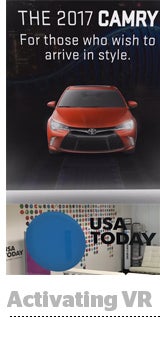
Each six- to seven-minute episode of VRtually There has original content, branded VR content and a VR ad unit USA Today calls a cubemercial. Toyota was the first brand to pilot the cubemercial to promote the 2017 Toyota Camry.
“We thought, ‘What if we took the idea of banner display, a billboard or a pre-roll and rebuilt that for a new medium?’” said Niko Chauls, director of applied technology for USA Today Network. “We created an experience where we’re not telling a long, narrative story with a beginning, middle and end, which is the function of branded content.”
The VR ad unit is designed for immersion.
“We found that with VR and 360-degree video, most people were only focused on branded content, which is important, but we wanted to test out what an ad unit native to VR content could look like,” Chauls said.

In Toyota’s case, a 10-second “cubemercial” renders within a seven-minute episode of VRtually There, allowing consumers with a VR headset or Google Cardboard, for instance, to explore the 2017 Toyota Camry from several angles within a virtual branded “cube.”
Publishers are investing in VR content, and USA Today Network is no different.
It launched Get Creative, a branded content studio focusing on interactive video and VR, in March and has since expanded the team to 410 people.
 While there’s tremendous opportunity to scale the format – USA Today Network has 119 million uniques each month – Kelly Andresen, VP of branded content for Gannett and Get Creative, said it’s still early days for VR.
And while publishers are building out VR offerings, many brands haven’t figured out how it works for their respective organizations just yet.
That’s why USA Today Network views its YouTube partnership as a way to increase audience sell-in and help commercialize a new-to-market medium.
“The idea is to grow the audience ecosystem through a regular cadence of VR content and creating that return habit for consumers,” Chauls said.
Another area of consideration is how marketers measure the medium, since interactivity can’t be quantified based on traditional video metrics like completions.
“You can’t apply standard video metrics to VR and expect the same results, which frankly, some people are doing with 360-degree video,” Chauls said. “We are working with brand partners, YouTube and third parties who are thinking about metrics in this new space to help define what engagement metrics in VR really should be.”







