

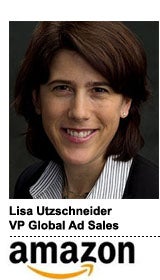
 The consumer packaged goods (CPG) market presents an opportunity for Amazon to better serve its customers, according to Lisa Utzschneider, VP of Global Advertising Sales at Amazon. Speaking at AdAge’s Digital Conference in New York City today, Utzschneider talked about her company’s approach to targeting ads and the growth of the CPG sector.
In discussing how customers shop online for products, Utzschneider focused on the modern consumer’s shopping experience as part of the “new normal.” “When my family needs something, I just go online,” she said. “Compared to the way my mom shopped — one trip to the grocery each week with nine kids — these are almost two different worlds.”
The CPG market is a $2 trillion business, and 2.3% of all CPG purchases will be made online this year, according to Utzschneider. Amazon’s eCommerce ads, allowing advertisers to embed a coupon with a call to action in a display ad, are a successful way for CPG companies to reach consumers, she added.

As an example, Utzschneider offered a Huggies campaign that its parent company Kimberly-Clark ran on Amazon. Kimberly-Clark wanted to promote a new pull-up Huggies diaper with $3 coupon and 20% discount through Amazon’s “Subscribe & Save” program.
Kimberly-Clark inserted the offers in a display ad, which consumers could redeem by clicking on the ad. After viewing the ad, customers were 13 times more likely to consider the product and 11 times more likely to buy it. The ad also led to $4.2 million in incremental offline sales for Huggies diapers, as well as a 14% lift in the perception of Huggies as a trusted brand. “Kimberly-Clark was extremely pleased with this campaign,” Utzschneider said.
In addition to interactive ads, ratings and reviews are also key to driving customer engagement. “Our customers prefer products that have a rating and review whether it’s positive or negative,” Utzschneider claimed. Customers were 25 times more likely to visit a product’s detail page if it included three or more reviews. “Customers really care about ratings and reviews,” she said.
As for other advertising opportunities, companies that don’t sell products on Amazon are increasingly interested in providing a branding experience there. Businesses like travel agencies and auto companies “see how engaged and loyal Amazon customers are and they want to put their brand in front of these customers,” Utzschneider claimed.








