

Amazon has become part of virtually every media plan and it’s only going to continue to grow.
Yet, Amazon’s advertising business remains an enigma. Even its closest partners aren’t exposed to the inner workings of its ad stack.
It’s also not clear how much spend flows through Amazon’s ad platform, though the investment bank BMO Capital Markets estimated that Amazon’s direct-response advertising business – which includes sponsored products, headline search and product display ads – could be worth $18 billion.
Citi Research projected Amazon’s ad business will grow to $50.6 billion by 2028, up from $10.2 billion this year, while JP Morgan estimates it will reach $4.5 billion this year.
That figure represents tremendous growth from previous projections, which estimated Amazon’s ad revenue to be in the $1 billion to $2 billion range last year.
Amazon’s advertising business runs deep, capturing dollars across digital media, shopper marketing, trade promotions, publisher offerings and ad tech.
Here’s a look at some of them:
Amazon’s Many Media Opportunities
Amazon has myriad media opportunities ranging from headline search ads to sponsored products, display and video.

 Most are accessible through Amazon Marketing Services, including headline search ads at the top of a page, sponsored products in search results, display ads along the right rail or ads within product detail pages.
Search and sponsored products are only available to Amazon vendors and third-party sellers on Amazon, and all search placements link back to Amazon, either in the form of product detail or brand pages.
Amazon Marketing Services also have a self-service capability typically used by small brands and manufacturers who want to manage their own keyword and display campaigns.
However, larger brands are more likely to engage with the managed services team, Amazon Media Group (AMG). Large manufacturers and CPGs like P&G and Unilever use Amazon for both branding and performance marketing.
And Amazon is primed to capture even more CPG dollars, as the increasingly price-pressured category looks to drive more efficiencies.
“The tenor of those conversations has changed drastically,” Amazon’s VP of global advertising, Seth Dallaire, said at AdExchanger’s Industry Preview conference last month.
Instead of evangelizing itself to brands, Amazon is now talking marketing strategy and tactics.
AMG can harness Amazon’s advertising capabilities beyond pay-per-click performance, and its network extends well beyond the main Amazon.com site.
If you want to advertise on Amazon Fire, Kindle and Amazon owned-and-operated sites and platforms like IMDb and Prime Video, you will likely go through AMG.
But Amazon also has plenty of new media channels and devices like the Echo, where brands like Campbell’s Soup and Moet Hennessy have invested in branded “skills” (or apps).
While Amazon has refrained from paid advertising on voice-activated service Alexa, could this change in the future? Brands like Sony are beginning to chafe at the inability to monetize the skills they’ve developed.
Amazon, however, denies it will allow ads on Alexa, the voice-powered operating system that powers the Echo device.
Ecommerce Meets Shopper Marketing
AMG’s purview has expanded beyond media sales into a practice called “ecommerce marketing,” the digital equivalent of trade or shopper marketing.
Ecommerce marketing provides prescriptive advice after analyzing a consumer’s path to purchase.
That practice can demonstrate, for instance, whether a retailer has enough inventory to deliver against its forecasted sales, or whether a media investment in search drove business results.
Amazon’s unique data set can show not just conversions, but also total volume of purchases or units sold on Amazon based on an ad exposure – aka product sales per media dollar spent.
That level of granularity is like gold to the trade/shopper marketing sector, which has evolved from in-aisle promotions and coupons and circulars to digital offers based on data from the likes of Amazon, Albertsons, Kroger, Walmart and Target.
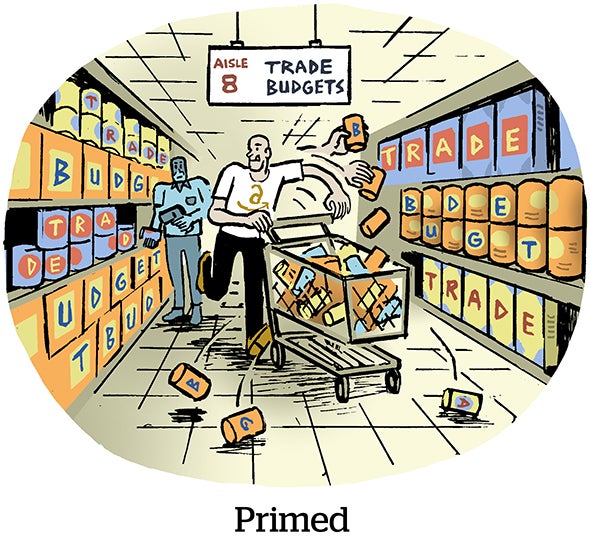 Trade marketing may be among Amazon advertising’s best-kept secrets, and could help the ecomm behemoth siphon budget away from Facebook and Google.
“Because we own both the media and the retail channels, we can give [advertisers] an end-to-end understanding of the customer journey, from ad exposure to awareness to conversion to loyalty – using actual first-party, retail metrics corresponding to each stage,” Dallaire said in a previous interview.
Amazon Ad Tech
Amazon’s advertising technology includes a demand side platform known as the Amazon Advertising Platform, or AAP, which buys web, mobile and video inventory programmatically across Amazon properties and third-party exchanges.
Despite its rep for being clunkier than some of its competitors, AAP has grown quickly and quietly, because its targeting data is unique and tied to a transaction.
That level of intent data is not only enticing to brand manufacturers who sell their products in the Amazon store, but non-endemic advertisers who want to know which categories or products index more highly among their target demo.
In a recent study by Advertiser Perceptions, Amazon’s DSP emerged as a leader, surpassing Google’s DoubleClick Bid Manager as the “most-used DSP” among a sample of 800 buy-side marketers.
“There’s a real trend where Amazon ad tech flies under the radar until it’s dominant,” said Advertiser Perceptions’ chief strategy officer, Kevin Mannion.
Besides media activation, Amazon’s buy-side ad stack also powers audience discovery and creative.
“We can use review information, how many stars a product got, as well as pricing information to easily and quickly create customized or templated creative [with] the most relevant offers,” Saurabh Sharma, Amazon’s director of ad platforms, said in an earlier interview with AdExchanger. “We offer all of that as part of our ad tech stack. And we make all of that available on both managed and self-service access.”
Amazon enhanced its audience targeting last June when it launched a CRM matching product called Amazon Advertiser Audiences.
Amazon Advertiser Audiences allows advertisers buying through Amazon to match their CRM or email lists to Amazon’s anonymized audience data and build segments and lookalike models.
On the sell side, Amazon has a header bidding product called the Transparent Ad Marketplace.
While the project is still clandestine, it appears to be spearheaded by Tim Craycroft, Amazon’s VP of worldwide advertising platforms.
Last year, Amazon’s Transparent Ad Marketplace really took off when it evolved into a server-side header bidding wrapper. (Here’s what that means.)
This move gave Amazon more power over auctions, at the expense of Google’s DoubleClick for Publishers. (Amazon also has A9, the elusive unit powering everything from algorithmic search to header bidding, to thank for that.)
And Amazon also hopes to own a bigger piece of the video supply chain.
Amazon Web Services launched AWS Elemental Media Services in late November to help media owners manage their live and on-demand video content while improving their yield.
Video workflows, until now, have been all but owned by Google’s DoubleClick and Comcast’s FreeWheel, but as Amazon seeks to grab more video dollars, it’s only natural the ecommerce company move closer to monetizing it.






