

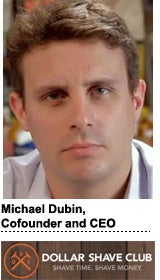
 Michael Dubin might be best known as the “Our Blades Are (Expletive) Great” guy, who amassed close to 11.5 million views of his viral YouTube video that helped catapult his LA- based company DollarShaveClub.com into the upper echelons of subscription commerce startups.
During a presentation at the Financial Times Future of Marketing Summit last week, Dubin outlined the growth of the digital lifestyle brand that now sells and ships razors and other personal grooming products to some 300,000 subscribers. Raising $9.8 million in Series-A funding last fall, the online brand is backed by Venrock, Andreessen Horowitz and a number of other investors and advisors.
Dubin spoke with AdExchanger.
AdExchanger: What inspired you to start DollarShaveClub.com?
MICHAEL DUBIN: Well, if you ask most guys how they feel about shopping for razors, most will tell you they’re frustrated with two things. One, the price and two, the frustrating experience of going to the store to buy them. I spent most of my career in marketing and media and I saw a market that was ripe for disruption, so I went for it. We launched a beta site in 2011 and ran it on a very small budget and had enough money to put into the [original] video. It was about $4,500 that we put into the video and I wrote it myself and I had a friend of mine who I had done some comedy with before, direct it. It was very homegrown. We [do] have an agency that helps us with our TV buying, our radio buying and we are working with some digital agencies on the buy side. Most of our creative is developed in house, though.

How has membership grown?
We launched the business on March 6, 2012 in its current version with the video, and that’s really when you can start to see that growth curve. We now have 300,000 active members. Retention-wise, I think people feel like they’re getting more than just a razor. They feel like they’re connected to this cool brand and there’s always something fun in the package every month and now there’s all these new products, so people are starting to look to Dollar Shave Club to solve their grooming and personal care needs with excellent personal care products.
You mentioned wanting to build a lifestyle brand and disrupt the traditional distribution model of personal grooming products. You also do ecommerce and viral content creation.
Dollar Shave Club is all about being smart. That’s really the keyword that supports our brand. Going to the store, sitting in traffic, waiting in line and fighting the razor fortress is not smart. Overpaying for products we can give you half the price for the market equivalent is not smart. Dollar Shave Club is smart. And our marketing is smart. People feel smart when they share [our content]. We’re really just defining the values we want our customers to know we stand for and ‘smart’ means a combination of price, convenience and a little bit of fun. Ultimately, I think building a brand is really where you can have the most significant impact on somebody’s life, not just selling products online.
How do you attract shavers?
We start with awareness at the top of the funnel and we’re using TV and radio to do that. And then obviously we do the smaller blocking and tackling online, search engine marketing and display and Facebook.
Do you have a loyalty program?
Right now you cannot accumulate airline miles by using Dollar Shave Club. In the future? Maybe. Anything’s possible.
You’ve worked with Media Design Group and attribution vendor Convertro to weigh the outcomes of promotional video vs. TV ad spend. Do you consider yourself a data-driven company or is there work to be done to tap into your subscription base?
I would say we are becoming one. At first, when you start a company, your resources are very limited. You can’t build very sophisticated tools that the big retailers and the big brands have, nor can you pay the big fees that the data companies that have the information charge you to get it. We are building our own data warehouse and we are getting very smart about what we collect and how we keep it secure and how we use it to better serve our customer.
How do you see your future mix of paid and earned media?
Right now I would say paid is more significant, as it drives a larger share of return. I would say that wasn’t the case in the earlier days because we really drove a lot of organic traffic, but now that we have the money, we can increase the awareness and you can do more when you pay. But over the long term, the goal is to be about 50% paid and 50% organic. I would say TV probably drives the most awareness for us right now.
What do you foresee as far as growth in the next two years?
Well, imagine an entire line of personal care and grooming products, so everything from hair care and body wash to post-shave and moisturizers. Which gets sequenced next? I don’t know. It’s a little bit about what comes out of the lab.






