

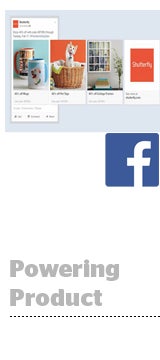
 Facebook on Tuesday rolled out product ads designed to let retailers connect their product lists with news feed units. Read the blog post.
Retailers traditionally have trouble syncing up inventory-level data with media, since the bulk of that information sits in transactional databases.
“With dynamic product ads, marketers can directly upload their product catalog to Facebook or set a schedule for Facebook to regularly download their product catalog,” said a Facebook spokesperson.
Product ads leverages the CRM connections that power its Custom Audiences solution. This lets retailers control which products appear in Facebook ads, to the point where they can even pull the plug on out-of-stock items.
Facebook also published APIs for product catalogs “that allows shopping engines to ‘push’ inventory updates to Facebook in real time,” the spokesperson said. In addition, it partnered with companies like ChannelAdvisor and Mercent to upload product feeds to Facebook.
Adam Berke, president and CMO of retargeter (and Facebook marketing partner) AdRoll said the format should help improve ROI, particularly in mobile.
“Having the ability to serve product-specific creative is such a needle mover when it comes to performance, and historically we were always able to run dynamic creative on desktop through FBX, but we were never able to do it on mobile,” Berke told AdExchanger. “Dynamic product ads allow us to leverage all this intelligence we built in terms of product recommendations and serve product-specific creative in the Facebook mobile news feed.”

Shutterfly.com and Target are early users of product ads. Target saw a 20% increase in conversions compared to other formats on Facebook.
Product ads come in two flavors. The first allows retailers to show different types of ad creative to different audience targets. To perform this, marketers must upload multiple creative assets to Power Editor (Facebook’s ad-editing tool).
The second type of product ad is more dynamic, as ad creative changes based on how Facebook users have interacted with an ecommerce site or app as well as product-level data around pricing and product availability. For instance, different creative might show depending on whether a consumer placed a product in her shopping cart or simply viewed it.
To leverage this type of unit, marketers can upload a product catalog to Facebook Business Manager and add a Custom Audience pixel to the company website.
Berke said the ability to onboard a product list and dynamically serve ads can be a tough technical challenge. After all, there’s always the risk of displaying the wrong price for a product or showcasing something unavailable.
“There are all sorts of foundational pieces [like] recommendation logic that you have to get right,” he said. “[Facebook] is prioritizing higher-quality ads like dynamic product ads that are more relevant to users and they’re able to generate more revenue by showing fewer ads that are personalized.”








