
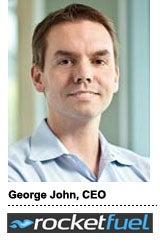
 Media-buying platform Rocket Fuel’s growth continued to shoot up in the fourth quarter, driven by – according to CEO George John during the quarterly call – a high customer-retention rate, increased sales productivity and reputation.
The company reported gross revenue of $85.6 million in Q4 2013, a 113% increase from the same period last year. Revenue excluding traffic acquisition costs (ex-TAC) was $49.6 million, an increase of 148% from the same period in 2012. Revenue for the full year 2013 was $240.6 million, an increase of 126% from the end of 2012 (FY revenue ex-TAC was $137 million, an annual increase of 145%).
John noted the the 126% revenue increase outpaced the growth rate of Rocket Fuel’s contemporaries. (In fairness, Rocket Fuel is much younger than many peers and its accelerated growth rate should be expected to an extent.)
Also, existing clients returned and increased spend.
“If we signed no new customers [in 2013],” John said, “we would have grown revenue 68% on 2012.” Rocket Fuel CFO Peter Bardwick added that despite the company’s increasing scale in 2013, it hasn’t seen a slowdown in customer-acquisition rates.

Some of Rocket Fuel’s largest areas of growth stem from multichannel campaigns. Mobile, social and video channel revenue increased 721% in Q4 2013 compared to Q4 2012. These channel cumulatively constitute 32% of the company’s total Q4 2013 revenue. Mobile, in particular, is the largest channel (19% of revenue), followed by social and video.
The popularity of the mobile channel spurred the development of Rocket Fuel’s Mobile Advertising Suite, a second-generation product released Thursday and designed to place ads across 16 mobile RTB suppliers, target customers most likely to conduct in-app purchases and use analytics to draw connections between consumer intent and geographic behavior.
“We’re at the very early stages of what we can do in mobile,” John said, adding that CEOs and CMOs now want to see results that justify spend in the channel. “Increasingly they want to understand how mobile is synergistic with other channels.”
Rocket Fuel’s algorithms automatically increase its media-buying and placement efficiencies for each client.
“This is completely different from relatively unintelligent database applications,” John said, “[which get their input] from people typing, not software.” (At a conference last December, he compared Rocket Fuel to Skynet, the artificially intelligent mastermind from the “Terminator“ movies.) Consequently, Rocket Fuel claims its technology can meet advertiser needs because it adjusts automatically to constantly fluctuating consumer habits.
Going forward, Rocket Fuel will continue its push into Japan and European countries. It will also increase its R&D spend to build out more products (Bardwick said related announcements are coming “later in the year”) around its core engine and applications for brand campaigns and mobile, social and video. And it will expand its self-service software and possibly make headway with small and medium-sized businesses (SMBs).
“We haven’t decided on the precise entry points,” Bardwick said of the small-business opportunity. He added that Rocket Fuel might begin incorporating for the SMB community better insights and visibility into how media is being purchased and distributed so they’ll get a “better idea on what Rocket Fuel is doing, rather than just getting better.”
If this happens, it would be a reversal of Rocket Fuel as a black box – a media-buying platform that traditionally delivered results based on its clients’ needs, without revealing how those results actually came to be.