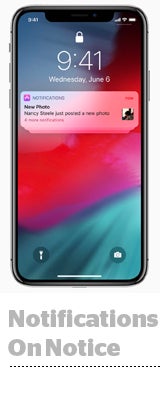
As Apple cuts down on lock screen clutter, app marketers should take notice.
In the wake of Apple’s latest do-not-disturb feature updates, which give users more control over their notifications, developers need to be judicious about how pushy they get with push notifications.
Once users disable push or banish notifications from the lock screen, they are highly unlikely to re-enable. But with the right approach, developers can inspire loyalty in users rather than exasperation.
“Too many of the wrong kind of notifications will likely cause users to turn them off – or worse, uninstall your app altogether,” said Adam Fingerman, chief experience officer and co-founder of Grey-owned app development studio ArcTouch.
To cut the number of app interruptions in iOS 12, Apple will allow users to manage push notifications directly from the home screen.
Users can either turn notifications off or have them bypass the lock screen and go directly to the notification center. People will be able to group notifications by category or topic thread and dismiss them all at once. They can also block all incoming notifications overnight and set time limits for the leave-me-alone mode.

Most app marketers rely fairly heavily on push for engagement and retention. Promotional push messages boost in-app spend by around 16%, according to mobile marketing platform Leanplum.
But developers and brands would do well to track how users and consumers engage with the notifications they send to ensure they aren’t pushing people over the edge with spam, especially as users start experimenting with their expanded do-not-disturb settings.
“Brands will need to double down on their notification strategy, focusing on utility and value over habitual gamification,” said Mike Herrick, SVP of product and engineering at app marketing automation and notification company Urban Airship. “Brands will also need to closely monitor their user churn metrics and more readily understand how to reach each individual in the moments that matter most.”
But Apple curtailing notifications shouldn’t be a big deal for apps and marketers that respect their users.
A potentially more meaningful new feature from Apple’s raft of WWDC announcements is Siri shortcuts, which allow users to embed voice commands within any app or create them through a dedicated Shortcuts app using a drag-and-drop function.
For example, someone could create a “heading home” shortcut that automatically starts playing NPR and serves up local traffic conditions, or quickly access hotel information in response to a “travel plans” voice command.
It’s pull, rather than push, said Tom Edwards, chief digital and innovation officer at Epsilon, and “that is the future of notifications and, ultimately, predictive notifications.”
Smart brands can also use the shortcuts to build loyalty by going beyond incorporating Siri shortcuts in their own apps to educating users on how to make them themselves.
“So many marketers talk about the consumer decision journey, [but] we live in a time of the empowered consumer, and it’s less about pushing content and more about seamlessly integrating into their worlds,” Edwards said.
“The key is to be ready to connect through virtual assistants. It’s about defining your brand within the voice service, as well as reinforcing with consumers how to activate with shortcuts – that’s a piece that’s been missing.”