

 You don’t need a physical store location to try beacons on for size – but not everyone thinks that’s such a great idea.
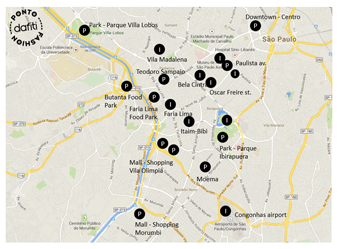
In December, fashion e-retailer Dafiti – Latin America’s answer to Zappos – started placing little Bluetooth-enabled devices in public places around São Paulo, Brazil, as part of an experiment in location-based contextual targeting. Think bars, restaurants, parks, newsstands and popular shopping streets.
Dafiti customers – those with the app installed and push notifications turned on – are pinged with messaging, content and offers based on where they are as they move throughout the city. Users can automatically save any discounts or coupons they receive on the go through an integration between the Dafiti app and Apple’s Passbook.
Say you’re on your way for a jog in Ibirapuera Park, a massive urban green space located in the center of São Paulo that sees nearly 200,000 visitors every week – you might receive a sports-related message as you walk past a newsstand outfitted with a beacon located near the park’s entrance. Or perhaps you’re going for a stroll down Rua Oscar Freire, one of the city’s ritziest streets, and you pass by a luxury store you’d previously expressed interest in. “Ping” goes your device with information about an upcoming sale on Dafiti’s site, a discount code or even a piece of targeted lifestyle content.
“Although Dafiti is an online retailer, we feel the need to be close to the consumer [and] we are working with technology and features which create proximity to users and which ensure our communication with them is relevant,” Dafiti co-founder and managing director Malte Huffmann told AdExchanger. “iBeacon technology is innovative, combines online and offline sales with context and subsequently allows communication to be more personalized.”
And there’s a lot of potential there to capitalize on – the mobile landscape in Latin America is exploding. According to Webshopper, mobile commerce sales increased 84% YoY from 3.8% to 7% last June.
It’s certainly a clever idea, but opinions are mixed about its true efficacy in terms of scale, potential regulatory issues down the line and, most importantly, how consumers will feel about it.

The value exchange has to make sense and the companies taking advantage of beacons need to make sure that the net result isn’t spam 2.0 – or whatever version the industry is up to now, said Dave Mathews, CEO and founder of NewAer, a self-styled “new-gen beacon platform.”
“People have a trust relationship with their apps and if you violate that trust and make them wake up their phone in a non-timely fashion, which is what beacons can do, people will either remove the push notification function or delete the app,” said Mathews, whose company recently worked with Unilever in the UK to create a radio wave-powered app for the Magnum ice cream brand’s 25th anniversary.
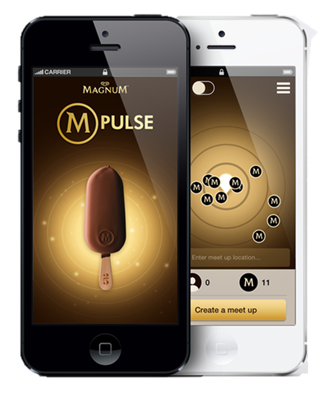 Users of Magnum’s M-Pulse app would be alerted when a friend who also had the app was nearby so they could use the opportunity to meet up and share an ice cream, and ice cream coolers located in grocery stores around London would send out a signal when a user of the app was in proximity.
NewAer also has a product it calls Kiosk, which takes advantage of digital signage and radio signals. If the signage recognizes that someone is wearing a fitness wearable, for example, it might display a coupon for a sports-related product. But, unlike push, users have to take the initiative and touch the screen in order to have the offer sent to their phone.
Speaking of push, it’s unlikely someone would re-enable notifications once that person has disabled them following an intrusive or irrelevant experience. That’s arguably part of why Facebook killed the messaging functionality within its flagship app, forcing users to download its standalone Messenger app if they wanted to chat with their friends.
“Most people have notifications turned off on the traditional Facebook app because they don’t want to go through their day getting pinged every time someone comments on something or likes a photo,” Mathews said.
With Messenger, Facebook can take a fresh stab at push – which is particularly relevant in light of recent news that the company is testing Bluetooth beacons in locations around NYC. Facebook’s Messenger app has more than 500 million monthly actives.
For his part, Joe Stanhope, SVP of marketing at martech company Signal, which helps advertisers consolidate their cross-channel data, applauds Dafiti’s experiment – with a couple of caveats.
“It’s far more interesting that just using beacons to figure out when someone is passing by a certain shelf in a store,” Stanhope said. “The cool thing about beacons, and mobile in general, is that is changes our conception of location because its capabilities are not bound by a specific place or store.”
Scale is a concern, however.
 “Yes, beacons provide an opportunity to try new things, but will it actually move merchandise? Will it create enough activity to move the needle for the company?” Stanhope asked. “Sometimes it’s a risk to pour resources into something like that.”
That said, Stanhope sees Dafiti, which ranked 19th on Internet Retailer’s 2014 Latin America 500 list, as exemplifying a certain innovative mobile-first spirit that would be difficult to harness in more established markets bogged down by “the baggage of direct response.” DR might form the cornerstone of Marketing 101 in the US, but it doesn’t necessarily make sense in a place like Brazil, for example.
“Some countries in South America don’t have standardized mailing addresses or landlines or broadband Internet connections, and companies in these economies will essentially skip a lot of the traditional uses of mobile and go right to experimental services,” Stanhope said. “That said, multiple pieces of data need to be stitched together because beacon data alone is interesting, but it only tells a portion of the story. You also need to understand attributes and behavior and bring that together with location.”
Although Dafiti is tracking several engagement metrics related to its beacon-triggered push notification, including open rates and customer buying behavior, the company declined to share specific numbers.
In terms of what Dafiti is doing on the data collection front, Huffman was a bit cagey.
“Everything that we track we save and keep in the database for the use of targeting in future,” he said.







