

 Deep linking is handy if a user already has the app in question installed. If not, the conversion rate is far from impressive.
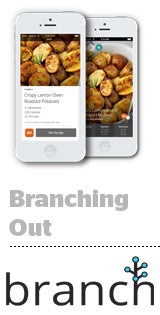
It’s an issue deep-linking company Branch is looking to solve with the launch of Deepviews, a tool that automatically replicates in-app content in the form of a mobile web page, as opposed to shunting users who don’t have the app installed to the app store.
The tool, which ran in limited beta with several Branch clients, including AlltheCooks, eBay subsidiary Close5, iHeartRadio, theCHIVe, 9GAG and We Heart It, was made generally available on Wednesday.
Say a friend sends you a link to a recipe on AlltheCooks. You click on the link, but you don’t have the AlltheCooks app on your phone, so you’re routed to an app store to download the app without a clear idea of the content you’re going to see on completion of the install.
Not only is that app store detour annoying – it doesn’t do the conversion rate any favors. For example, before enabling Deepviews, AlltheCooks was seeing a conversion rate of 3% to 4%.
“I’ve seen how well a mobile site can work to drive installs and have continued to hear the frustrations of users who get taken to an app store instead of seeing the recipe they clicked on,” said AlltheCooks CEO Rafael Sanches.

Deepviews works by using templates to create mobile web-friendly previews of deep-linked content. When a user takes an action, such as sharing a particular piece of in-app content, a preview of that content is laid out automatically. A call to action directing users to download appears below.
Even though it’s adding an extra step in the process, giving users a sneak peak of the kind of content they can expect from an app has had a salubrious impact on conversion rate. Since switching on Deepviews, AlltheCooks has seen its installs increase to around 22%.

In iHeartRadio’s case, the conversion rate jumped from around 3% when the online radio app was sending users directly to the app store to download to around 13% when it gave users a chance to preview content.
For the moment, each Deepview is created on an ad hoc basis when a user shares a specific pieces of content. Within the next several months, Branch is planning on rolling out functionality that will scrape an app’s entire content library to make the entire thing automatically available all at once through the Branch SDK.
“When users click on a link, they’re making an investment in your business because they want to see something you’re going to show them,” said Branch CEO and founder Alex Austin. “Sending them to the app store is a very disruptive experience. But if you can deliver some sort of payoff earlier, like a preview of what they would get in the app if they downloaded it, they’re more likely to convert.”
Another happy side effect is that Deepviews are searchable through all the major portals, including Google and Bing.
Which is handy, because search can be a bit problematic for app-only companies. Although Google, Apple, Facebook and others have been focusing their attention on indexing app content for search, those efforts only apply to apps that also have a corresponding website.
Rather than having to put in the effort to create and maintain a mobile site, the Deepviews also function as mobile web pages, enabling the app to get indexed and become searchable.
“An app can’t index on Google unless it builds a website and adds some tags to let Google know how to link to the app,” Austin said. “We have more than 2,000 apps using Branch and most don’t have mobile websites.”
Headquartered in Palo Alto, Calif., Branch has raised a little more than $18 million to date, including $2.8 million in seed cash in September, followed five months later by $15 million in Series A led by New Enterprise Associates and TriplePoint Capital. Headcount has increased from about six people in September to a little over 40.








