
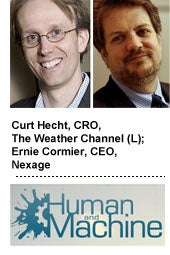
 For digital advertising to advance, innovation is required from both the creative and engineering sides. The question of how to keep the two parties in sync was central to a discussion of mobile advertising at a conference hosted yesterday by The Weather Channel in New York City’s Meatpacking District.
Curt Hecht, chief revenue officer of TWC, moderated a panel at the company’s Human And Machine presentation. He focused the discussion largely on mobile for the obvious reason that ad space there has reached a stage of important development. Plus, mobile is an increasingly important platform for TWC, which is still primarily identified as a cable TV channel.
“For us to be successful, we know we need to get the branding/creative part right, because that’s what drives engagement, Hecht said. “Even though I come from the programmatic, data-driven side of the media business, I have a passion for creative. My brain might not necessarily be wired that way, but I am stimulated by it. Automation is happening, there’s no question that Google, Facebook, Twitter and publishers like us, rely on the machine as a large part of our business. But unless the user is engaged, it won’t work. You can’t have a programmatic marketplace without a creative marketplace.”

The need for efficiency and scale means something different for web and mobile, participants noted. Ernie Cormier, CEO of mobile ad exchange operator Nexage, called for the creation of a limited set of new mobile ad formats that could spur spending higher than the $7 “premium” CPMs that branded mobile ads can command on the high end.
“If we want mobile advertising to grow in exchange-based platforms, we recognize that there’s innovation that we can still do within the ad unit types,” Cormier said. “The ones we have now can be effective, but there’s room to do more. The expansion of mobile ad units has to happen in a disciplined manner. You don’t want a lot of custom ad types out there. If you want to have repeat use and interest by multiple buyers, you want to be able to standardize.”
There are multiple reasons some are calling for better user engagement opportunities in mobile. First, consumers tend to be more excited by new mobile offerings, whether it’s Apple’s latest iPhone or new apps, as opposed to the PC-based web, which is largely established in the minds of consumers and advertisers. With mobile, because there’s so much rapid change and constant experimentation, there is a chance to get the methods and models right before the mobile ad industry is set in stone.
Second, there’s a realization that even as marketers and publishers stress the need for “seamless” experiences across all screens, the mobile experience, as a more portable personal device, will still demand a different approach from what consumers want and expect in terms of content.
“In a prior life, I was a marketer, and I was spending a lot of money advertising,” Cormier told AdExchanger after the conference. “If an agency I used had ever come in and said that they were not going to treat mobile as a special platform, that it was just an extension of online, I would have fired them. Anyone who says that, clearly doesn’t get that when someone is using mobile, they’re in a completely different mindset and experience. And the advertising has to recognize that in order to be effective.”
But where does a mobile RTB specialist come to demand greater creativity from publishers and agencies?
“Mobile RTB is growing very fast and if you want to do a scaled, targeted campaign in mobile – and I’m talking about something much more specific than someone who wants to just reach all iPhone users in the U.S. – the only option you have is the exchange,” Cormier said. “That’s a fact of life. Inevitably, no matter how we work out privacy, creativity, verification, brand safety and all these other loose ends, the middle will be a real-time bidding exchange where marketers and publishers will be able to move that inventory.”






