

 Drivers and passengers buy about $225 billion a year in consumables at gas station convenience stores. That’s a lot of candy bars and potato chips.
But targeting that on-the-go audience with specific offers and connecting sales to specific ads is far from convenient for marketers and retail operators, which comprise a highly fragmented landscape of mostly independently owned franchises – around 96,000 in the US alone.
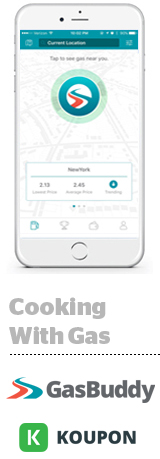
On Wednesday, GasBuddy announced a partnership with Koupon Media, a platform that helps brands and retailers create, manage and distribute mobile offers. The company works with around 43,000 retailers across the US and has deals with a number of CPG brands, including Mountain Dew, Coca-Cola, Mondelez, Frito-Lay and Pabst Blue Ribbon.
“Snacks do incredible volume in convenience stores, but there’s no good way for CPG brands to promote these products and do attribution,” said Greg Fox, CRO of GasBuddy, an app and website that crowdsources gas price information to help its more than 60 million users find the best deals at the pump.
Most of those purchases are made without much consideration, which makes tracking and targeting even trickier, Fox said.
“People plan their trips to the grocery store, but 80% of all purchases from a convenience store are spur-of-the-moment decisions and the products are eaten within 30 minutes,” he said. “It’s all about instant gratification – and that’s also what mobile can provide.”
GasBuddy receives 50 million fuel price submissions from its users per month, but only 30% of those people actually make it into the convenience store attached to the station they’re buying gas from. Of those, the app can determine footfall attribution through a partnership with location data platform Cuebiq, but not whether users bought anything.
That’s where the mobile coupons come in. People often take their phones out while they’re waiting for their tanks to fill up – according to GasBuddy, dwell time at the pump is around five and a half minutes – which makes it an optimal moment to surface a message with an enticement to come into the store.

When an offer is redeemed, Koupon Media creates an anonymous unique identifier for that user and start adding data to a profile, including when and where the coupon was used and what was bought. That information is shared back with the brands and retailers so they can refine their future offers.
Koupon targets offers based on general redemption patterns and contextual inputs like geo, weather, region and time of day, and on individual user preferences collected over time. It’s CRM for convenience stores.
“GasBuddy has the right users and we have the content and the relationships with retailers to make the recommendation process go all the way through to an action,” said Koupon Media CRO Brad Van Otterloo. “It’s hard to get that first engagement, but using mobile coupons is habit-forming. And it makes sense for people to open their phones while they’re waiting to get gas, unlike in a grocery store where it’s unnatural to have your phone out.”
That’s why beacon programs, which seemed to hold so much promise for supermarkets, haven’t made much of an impact beyond the experimental.
“Think about it – people in grocery stores are pushing a cart, they’ve got their kids grabbing things off shelves, they’ve got a list and they just want to get in and get out,” GasBuddy’s Fox said. “But we know people are opening up their phones when they’re filling up on gas because we get tens of millions of submissions a month. That makes it the ideal time to reach them.”
Koupon claims a 10-12% redemption rate on its coupons, discounts and promos.
“We’re looking to create a scenario where everyone wins,” Fox said. “Users benefit because they’re getting a great deal on an item in the store, the stores benefit because they’re driving more people and selling additional products and the CPG brands benefit because now they have a way to reach convenience store customers almost like a digital version of the Sunday circular from Kroger.”
Beyond coupons, GasBuddy recently rolled out a feature called business pages, a BI tool within the app that retailers can use to track analytics about themselves, like how many times their location comes up in a search, how many clicks they receive and how many people have visited their station, as well as to see crowdsourced rankings and reviews of the user experience and their amenities, like the cleanliness of the bathroom or the alacrity of the service.
The Cuebiq partnership, struck in early October, is also just starting to rev up, with plans to start building anonymous user profiles and segmenting users based on historical location, tracking footfalls and analyzing the effects of ads on store traffic.









