 Glu Mobile wants users who will stick around for the long term.
“In the past, a game company could put out a game every month, just throw stuff out there and see what stuck,” said Glu CRO Chris Akhavan. “But now, consumers only have so many apps they actually use regularly, and we’re all fighting to be one of those.”
Licensing IP from celebrities has become a cornerstone of the publicly traded game developer’s strategy in the battle for precious home-screen real estate through partnerships with Kim Kardashian, Gordon Ramsay, Jason Statham, Kendall and Kylie Jenner, Britney Spears, Nicki Minaj and Taylor Swift.
But the same formula doesn’t always do the trick. Some games become monster viral hits, like “Kim Kardashian: Hollywood,” and others arguably flop, like “Katy Perry Pop.” On Wednesday, Glu hitched its wagon to another star with the release of its “Nicki Minaj: Empire” game to try and recapture the lucrative Kardashian magic.
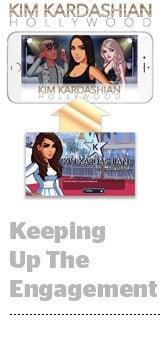
The Kim K game, which got an update last week, has been Glu’s most successful celeb offering, despite being released two and a half years ago.
The game has generated around 42 million downloads and somewhere in the neighborhood of $200 million in revenue since mid-2014. Although it had only $6.7 million in bookings last quarter, down from previous quarters, that’s par for the course even for a popular game as it gets long in the tooth.
The bulk of Glu’s revenue comes through in-app purchases. But a healthy chunk of Glu’s revenue – between 20% and 30% – is advertising-based.

Although Glu declined to comment on how a celebrity’s IRL (that’s “in real life”) actions and experiences affect downloads and engagement – for example, Kim Kardashian’s social media blackout after she was robbed at gunpoint in Paris in October – it stands to reason that there must be some effect, which could sometimes be detrimental.
But fans are almost always willing to spend both time and money on a game powered by a celebrity or brand they have an emotional connection with. “They already have built-in passionate fan bases,” Akhavan said.
AdExchanger caught up with Akhavan to talk programmatic, retention strategies, its November acquisition of female-focused mobile gaming company CrowdStar and about why Glu is more than just a maker of celebrity apps.
 AdExchanger: Why are celebrities such an important part of Glu’s strategy?
CHRIS AKHAVAN: In the early days on the app stores, you’d probably get most of your revenue within the first couple of months and then your game would die. Now it’s shifted to what we call a live services model, where launching a game is just the very first step. It’s about constantly keeping your game fresh.
Today, app success means retaining a passionate audience for years. With Kim Kardashian and Taylor Swift, we’re tapping into personalities that people obviously know well.
Although we’ve been labeled as a celebrity gaming company, mainly because of the Kim Kardashian game, and celebrity is certainly a big part of our strategy, we also have major brand partnerships across the rest of our portfolio.
Which brands do you work with?
We have a partnership with the MLB for “Tap Sports Baseball” and we feature real baseball players in the games, including Kris Bryant from the Cubs. We also have partnerships with real car brands – BMW, Ferrari – for “Racing Rivals.” Those relationships power the authenticity of our games.
And in early November, we acquired CrowdStar, which makes a very successful social fashion game app called “Covet” that lets people dress avatars in apparel from hundreds of real fashion brands and compete in fashion challenges
During the Q3 earnings call, your CFO, Eric Ludwig, said Glu is betting on being able to increase the average revenue from advertising in “Covet” by 16%. How?
Even though “Covet” is close to three years old now, their revenue has continued to grow year over year. But in terms of the revenue opportunity, Glu generates higher revenue per user through ads than “Covet,” which has mainly monetized through in-app purchases. We see that as a chance to bring our ad revenue monetization experience to their apps and increase their rates for them.
What’s in Glu’s monetization arsenal?
Our key format is full-screen interstitial ads that we tend to show at natural pauses in gameplay, either when someone has finished a level or completed an action. We also run a lot of rewarded ads, especially video, and offer wall units where users can earn virtual currency for taking actions, like signing up for a magazine subscription. More recently, we’ve been experimenting with native ad formats.
What about programmatic?
Our ad revenue is heavily programmatic. We’re plugged into RTB exchanges and we also have a lot of direct SDK integrations with networks that we work with very closely. MoPub is our preferred SSP.
But internally, we’re always thinking about segmentation. We look at a lot of different factors, including whether a player is a heavy purchaser or a frequent player and how many sessions they play, and we use those characteristics to segment users and show ads at different frequencies. We’re always running tests on ways to maximize ad revenue without harming the user experience.
How difficult is it to create a follow-up to something as viral as the Kim Kardashian game? By most accounts, Britney Spears only did so-so.
It’s about striking a balance between delivering a portfolio of evergreen titles like “Covet” while hopefully growing them year on year as our core for stability while we work on delivering new titles that can be hits on the scale of Kim K or larger.
The challenge is that consumers’ expectations have gone through the roof, so you have to be extremely innovative if you want to get people excited. You can’t just add a few things to a title and call it “Kim Kardashian: Hollywood 2.” There needs to be surprise and delight with every new release.