

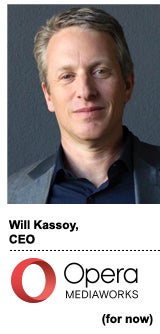
 Although Opera Mediaworks is no longer packing its bags and moving to China, newly minted CEO Will Kassoy is still bullish on the opportunity there.
“China is a huge market for advertising,” said Kassoy, who took the reins from former company chief Mahi de Silva in December after roughly two years as CMO. Kassoy joined Opera Mediaworks in 2014 after the acquisition of mobile video ad network AdColony.
But Opera Mediaworks will still tap the Chinese market, albeit from the inside out rather than the outside in.
A $1.2 billion offer from a consortium of Chinese companies to buy Opera fell apart in mid-July due to regulatory hurdles around data privacy.
In its place, a new deal was struck, with the consortium agreeing to pay $600 million for Opera Software’s consumer-facing business, including its mobile and desktop browser, its performance and privacy apps and a few other assets.
The rest of the business – Opera Mediaworks, Opera TV and Opera’s apps and games – will spin off into a separate independent company with a new, yet-to-be-determined name. The new entity will remain a publicly traded company on the Oslo Stock Exchange.
Losing the Opera name will be a little bittersweet since it built a lot of brand equity over the years. Yet it also represents a chance to ditch “the shadow of the browser,” Kassoy said. The market has always been a little confused about the advertising arm of Opera.

“This is an opportunity to define who we are, what we do and what role we play in the ecosystem,” Kassoy said.
Part of that effort is an internal initiative called Project Apollo to unify all supply and demand across each platform in the Opera Mediaworks stack, into what Kassoy called “one new programmatic infrastructure.”
There’s a lot in there: AdColony (mobile video ad network); AdMarvel (mobile ad serving); AdVine, Mobile Theory, Apprupt and 4th Screen (mobile ad networks); Hunt Mobile Ads (mobile monetization); and Handster (mobile app store platform).
The goal is to fully integrate everything by the beginning of 2017.
The integration project would be an important item on the Opera Mediaworks road map regardless of the recently scrapped deal, which Kassoy claimed was undone by bad timing.
“There weren’t any red flags, we just didn’t start the regulatory process on time so we didn’t finish on time,” he said.
But it’s undeniable that regulators seem increasingly concerned about the throughline between data-driven advertising and consumer privacy. Last year, a Forrester report predicted that privacy concerns would hit a tipping point in 2016.
“Privacy is a game changer,” wrote senior Forrester analyst Heidi Shey. “It will be to organizations in 2016 what websites were to companies in 2000.”
That certainly seems to be the case so far. In late June, mobile ad network InMobi felt the wrath of the Federal Trade Commission after transgressing the Children’s Online Privacy Protection Act by tracking geolocation without parental consent. And smart TV manufacturer Vizio, which just sold to Chinese electronics company LeEco for $2 billion, found itself on the wrong side of the privacy issue more than once for collecting and reselling TV viewing data to third parties without explicit consumer opt-in.
Privacy is taking center stage for regulators, but they also need to bone up on how ad tech works, said Kassoy, who avowed that Opera Mediaworks’ terms and conditions are explicit about what types of data publishers share and how it’s used.
“Sometimes when you’re going through the regulatory bodies it’s a bit like you’re doing a 101 session with them because they’re just not as close to it as we are,” Kassoy said. “There’s a huge educational process you have to go through.”
Regardless, US regulators didn’t cotton to the idea of a full-scale sale of Opera’s assets.
But that isn’t stopping Opera Mediaworks from maintaining its business relationship with the Chinese consortium, comprised of mobile game maker Kulun and security software provider Qihoo. As of June 2014, Qihoo’s mobile antivirus products alone had 641 million users worldwide.
“Despite the deal not going through, this whole process did allow us to start a relationship with a series of companies in China to help us build and grow our business there, and now we have a monetization relationship with some of the most powerful apps in the ecosystem,” said Kassoy, who noted that the Opera Mediaworks SDK footprint is second only to Google’s, according to a Mixrank audit of the top 1,000 iOS and Android apps.
But monetization isn’t necessarily something you have to own.
Qihoo has its own internet browser business, which made owning Opera’s browser more strategic than owning Opera Mediaworks and the other ad-related businesses. Opera’s browser is known for its data compression technology, and that’s attractive in emerging markets where there’s comparatively less available bandwidth.
Whether Opera Mediaworks will get acquired down the line – or continue acquiring mobile ad companies as in the past – is still an open question. For now, Kassoy plans to focus on a three-pronged plan: growth, new products and the Apollo unification project.
“Are those things going to be attractive to a big acquirer in the future or will we continue on as an independent? I don’t know,” Kassoy said. “But I do know that for now we’re more agile than a lot of bigger companies out there, and we’re going to keep our head down and keep working hard to build the business.”








