

As Johnson & Johnson’s senior manager for shopper marketing, Kris Cevasco spends most of her day figuring out how to get people to buy more stuff from grocery stores.
But ensuring that her efforts result in a mutually beneficial arrangement is a lot harder than it sounds.
Retailers are looking for ways to bring in more revenue through cross selling, introducing new products or creating new usage occasions. If J&J convinces someone to switch to one of its brands over another, that’s good for J&J, but it doesn’t necessarily make a difference to the retailer’s bottom line unless the person is also spending more money in the store.
J&J wants to keep its retailer partners happy, but obviously, it also just wants people to buy J&J stuff.
“So, any solution we suggest to our partners has to be something that brings a new person into a category or gets somebody to trade up or try a new routine,” Cevasco said.
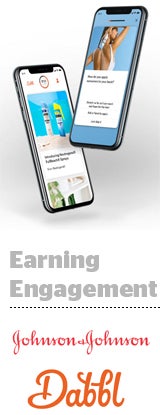
One new tool in J&J’s shopper marketing and media arsenal is Dabbl, an app for iOS and Android that lets users earn gift cards for engaging with ads. Clients include Mondelez, Barilla, Hormel, Duncan Hines and Poland Spring.

The app presents users with a branded video, quiz, survey or, more often, a combination of all three, which takes around 30 seconds to complete. At the end, users can rate whether they enjoyed the experience. They earn between 5 and 10 cents toward a $5 reward card in exchange for feedback and a little attention.
Dabbl also powers Downtime Dollars, a function within the Shoprite app that allows users to watch short videos in exchange for cash that automatically accrues to their store loyalty card.
The ads are opt-in, and most users complete the experiences they start. The recall is fairly high. One food brand that Dabbl works with saw 97% brand recall after exposure.
That’s the sort of engagement Johnson & Johnson wants as it attempts to spark a two-way interaction with its target consumer. “She’s on digital, so we need to be there, too,” Cevasco said. “Here, she opts in to interact, and we get to tell her our story.”
And grocery stores benefit from the added brand awareness and increased purchase intent.
With a June campaign to promote a new sun protection line from Neutrogena, for example, Johnson & Johnson wanted to educate shoppers about the products’ unique points of difference, such as an extended handle for easier application.
“If someone chooses to interact with Neutrogena on Dabbl, they learn something about the brand they didn’t know before,” Cevasco said.
They also get interested in making a purchase. Dabbl charted an 82% increase in overall purchase intent after the two-week Neutrogena campaign, with an average of 45 seconds spent engaging with each experience.
J&J saw similar metrics for a Tylenol campaign than ran for two months starting in late December. The Dabbl-exposed audience had 86% positive purchase intent, which led to roughly $20,000 in sales directly attributable to the campaign.
Twenty grand might not sound like much, but it’s a proof point. It’s not easy to make it from the testing bucket to a more enduring spot on the media plan.
“At this point in time, we’re mostly still part of the experimental budget,” said Dabbl CEO Susan O’Neal. “The biggest challenge is finding that more permanent place in the budget.”
Even so, Johnson & Johnson was pleased enough with the results to launch another effort. In late July, the brand kicked off a massive omnichannel campaign for its Johnson’s Baby relaunch with Dabbl on the plan.
And the more brands that sign up with Dabbl, the better. Dabbl only posts a handful of new campaigns a week – somewhere between five and eight – but it’s having trouble keeping up with user demand. Seventy-two percent of its users have asked for 40 or more so they can earn cash quicker.
“The day that media buyers feel that same pressure will be a beautiful day for us,” O’Neal said.









