


While mobile app advertising is in dire need of standards, that prospect is easier said than done.
Confusion and wrongheadedness in the industry is rife, even among user acquisition specialists.
“Ask a room full of UA managers to explain how mobile tracking works and I think most won’t be able to explain the whole process,” said Jonathan Winters, head of user acquisition at MiniClip, a mobile gaming studio with more than 1 billion downloads across its portfolio.
Which makes it difficult to address all the culprits that impede new standards, including varying attribution windows and the use of last-touch attribution methods like post-click and post-view.
Outing The (Attribution) Window
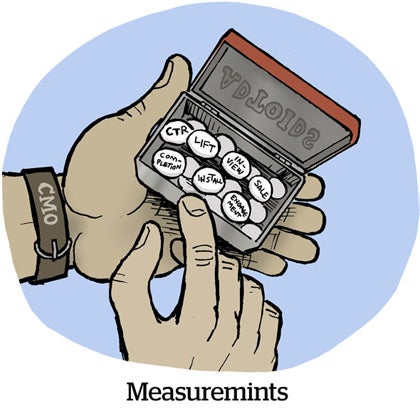
While defining an attribution window – the maximum amount of time between click and conversion – should be simple enough, most attribution vendors claim credit for an install if the click happens within a week.
But seven days is “arbitrary,” said Chris Kane, founder of Jounce Media, a consultancy that helps marketers navigate programmatic buying.
And the biggest app-install source of them all, Facebook, has a post-click attribution window that’s 28 days long, that allows it to claim credit for installs nearly a month after exposure.

Yet in an average mobile acquisition campaign, around 90% of downloads happen within the first 30 to 60 minutes, according to mobile measurement platform Adjust.
“But the longer your attribution window, the more likely it is that your ads will be assigned some value,” Kane said. “Set it for 28 days and a lot of ads are going to fall into that window.”
Long attribution windows also make it difficult to determine incrementality because organic installs can get counted as paid conversions.
Ad networks and media partners aren’t incentivized to solve for incremental attribution lift – they’re incentivized to sell more ads, Kane said. Last-click attribution is still primarily what gets them paid.
But “marketing needs to be judged on performance,” said Peter Hamilton, CEO of mobile measurement platform Tune.
“The only way to know if it’s performing is if you’re always comparing apples to apples, meaning you have standard clicks, impressions and views connected to downstream events,” Hamilton said.
 Deaf As A Post (View)
A click-based attribution system doesn’t acknowledge the value of ads that weren’t clicked and opens the door to fraud by encouraging bad actors to flood the ecosystem with junk traffic.
But post-view attribution, which gives full credit to the last ad a user sees before converting even if there was no click, is also deeply flawed, especially if it’s employed without scrutiny and in combination with long attribution windows, said Adjust’s fraud specialist, Andreas Naumann.
Most players in the industry, including Facebook, provide a 24-hour post-view window. Depending on the app or the offer, however, it doesn’t make sense to give credit for post-impression conversions outside of a few hours.
The fact is, consumers scroll by hundreds of ads on any given day, including on Facebook, and having post-view on all of them could wildly exaggerate their value.
Yet a top-of-the-funnel ad viewed days before a download could have a credible impact.
“I notice Instagram ads when I’m scrolling through my feed because they’re usually compelling and well-designed,” Kane said. “That doesn’t mean I click on them, but they do have some value.”
Additionally, walled gardens like Facebook have their own blind spots, said Kane, who noted that they don’t share enough data for marketers to determine incremental value.
You might see a Facebook mobile ad for “Clash of Clans” followed by a desktop browser ad but only buy after hearing an ad on Spotify – and Facebook would claim full credit for that install.
While Facebook can connect app downloads to ads viewed on its own network, Kane said, “they simply can’t see the fact that you might also have been influenced by something else.”
It’s Complicated
But setting a standard for mobile attribution windows incorrectly assumes that all media is created equal, said Kochava CEO Charles Manning. He called configurable attribution – the ability to adjust windows and waterfalls based on media source – ”critical to marketers who scale.”
Social dating apps, for example, see 85% of their conversions happen within a matter of hours. It takes gaming apps 36 hours to see similar results, and roughly seven days for financial services apps.
Logic dictates that different ad formats also deserve varying degrees of credit. Why should a banner languishing at the bottom of a news app get more credit than a full-screen vertical video interstitial?
At MiniClip, Winters and his team try and account for the qualitative difference between formats by only activating post-view for video networks and not for display.
“It doesn’t make sense to have one strict attribution window for both because you might either overestimate a small banner with a post-view or underestimate the power of a Snap vertical video in the Discovery feed,” Winters said.
 But defining standard windows by ad format doesn’t automatically mean credit is going where credit is due, although it would give certain ad networks advantage over others.
Technologies, processes and analysis methods also differ between businesses and across industries, said Ben Roodman, director of partner development for North America at AppsFlyer.
“Advertisers require flexibility when it comes to how they can use their data that takes into account unique goals, campaigns [and] business objectives,” Roodman said.
That’s why the buy side needs to put pressure on the industry to push for change, said Maor Sadra, managing director and CRO of mobile marketing platform AppLift, which has been reaching out to attribution vendors and app clients in recent months to jumpstart a dialogue on creating standards for the space.
Change often comes from the top or, more accurately, from the bottom line.
But considering all of the vested interests flying around the mobile attribution space – ad networks incentivized on last-touch, the buy side’s wariness of ad networks and the fierce competition between attribution vendors – it’s probably best for an industry party like the IAB or the Trustworthy Accountability Group to take the lead.
“If advertisers run the whole thing, they’ll do what’s best for themselves and leave out the publishers, while ad networks have their own motives,” said Adjust’s Naumann. “When this whole standardization thing finally happens, my feeling is that it needs to be a big forum with somebody independent.”










