 Static ad content is just too old school for apps.
That’s the thinking at Quixey, a company mostly known as an app search engine.
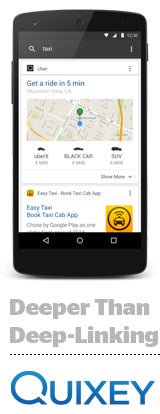
On Thursday, Quixey announced the release of Deep View Cards, a technology that generates dynamic creative in-feed ad units that mimic an app’s native UI and user experience. The product, now generally available, was in closed beta for the past six months.
But the term “ad units” is actually a bit of a misnomer, said Tomer Kagan, Quixey’s CEO and co-founder.
“Whereas websites are principally static pages of content – information, words, links – apps are software and they operate as software,” Kagan said. “Apps are built around functionality. When you open an app, it doesn’t load every piece of content every time. It uses its own logic to allow you to do a specific thing.”
Deep View Cards are based on the same concept – native widget-like units that update in real time.
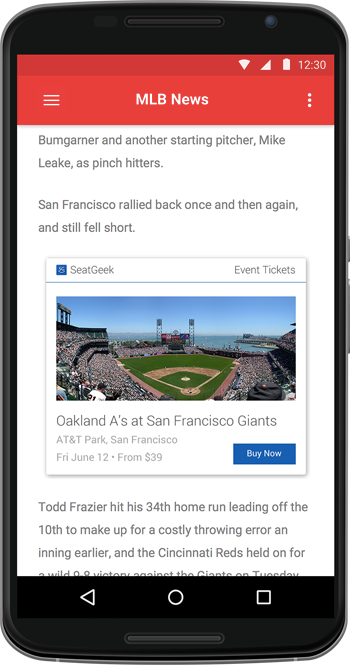
For example, nearly every user who opens SeatGeek, a Quixey client, to search for tickets to a sporting event or a concert will see different content based on who they are, where they are, what they’re searching for and when the search is being performed – but all of the results will be presented within the same template.
Quixey uses a proprietary technology it calls App Mining to deconstruct an app into its constituent functions. SeatGeek users might search for baseball tickets, football tickets or Madonna concerts or simply want to be notified of nearby events.
Quixey takes those various functions and creates a dynamic widget that pulls in the relevant information for whoever’s viewing it.

A consumer in Pittsburgh with a known affinity for the LA Dodgers, for example, would see an ad promoting the team’s upcoming away game, including the price. As the game draws nearer and the cost of a ticket goes up or down, that price change is dynamically reflected in the creative. Upon tapping to buy through SeatGeek, the user would be deep-linked directly to the right spot in the app.
Previously, SeatGeek saw success targeting users through Facebook and Twitter based on similar principles – but the creative and copy were static and the creation process was manual.
 “As you can imagine, there are hundreds of different permutations of events and games every year,” said Will Flaherty, director of growth at SeatGeek. “Unlike some other ecommerce merchants, our prices fluctuate all the time and it’s incredibly difficult to reflect that manually.”
Since hooking up with Quixey for Deep View Cards, SeatGeek’s click-through rates have increased by 20% or more, generating 150% higher conversions.
The cards are also available programmatically through several different exchanges and networks, including Adelphic, Opera Mediaworks and PocketMath.
“It’s intuitive and it’s logical, but we do need some technical help, because it’s not humanly possible to do this without programmatically applying intelligent ad creative beyond just the big social networks,” Flaherty said.
Native in general has been performing well for Adelphic.
“We’ve seen higher conversion rates on native – approximately three to five times higher – than on standard display,” said Jennifer Lum, chief strategy officer and co-founder of Adelphic.
For PocketMath, native is still a small part of its overall business, but “it’s picking up pace and adoption from customers is gaining steam quickly,” said company co-founder Casey Grooms, who noted that he’s seeing an “increased level” of engagement with the Deep View Cards.
And engagement is what Quixey is looking for.
“The whole notion of app install ads is a house of cards,” Kagan said. “If no one ever opens your app again or they just do it once and then forget about it, you haven’t accomplished anything.”
Quixey has more than 300 employees spread across offices in Mountain View, Calif., Beijing, Bangalore, India, and Tel Aviv. Since it was founded in 2009, the company has completed six rounds of funding totalling $134.9 million, including the most recent cash infusion, a $60 million Series C in March led by Alibaba – also a Quixey client – with participation from GGV Capital, Goldman Sachs and Softbank.