

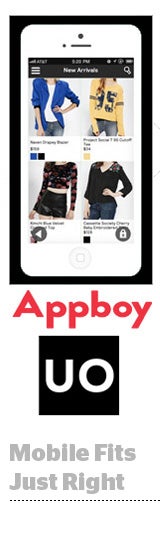
 Urban Outfitters’ target customers might be married to their phones – but it’s more of an open relationship than one might think.
“The attention deficit disorder in the population we’re trying to serve is the highest of any business I’ve worked at,” said Jim Davis, the apparel retailer’s director of CRM and interactive marketing.
“The question is always, ‘What’s next? How do we wow you now?’ But if we weren’t also serving up analog experiences like in-store concerts or record signings, I don’t know if our business would be as successful as it is right now,” he said.
Urban Outfitters considers itself a “lifestyle brand.” As such, its mostly millennial consumer base expects a perfectly blended omnichannel experience that uses digital to encourage offline interaction with the brand and vice versa.
But mobile is arguably one of the most vital ingredients in that mix, which means that targeting – and timing – is everything. Urban Outfitters works with app automation company Appboy to optimize delivery of its push messaging, email and in-app notifications based on when a user is most likely to be in a responsive mood.
“You need to understand where your user is and what they want to do right now vs. two hours from now, because in two hours you’re going to need a different message,” said Mark Ghermezian, CEO and founder of Appboy, whose client list also includes Gannett, Microsoft and Samsung.
To do that, Urban rolls up its sleeves on data collection. Consumers who download the Urban Outfitters app become part of Urban On, the brand’s loyalty program. Users are required to provide an email address and are encouraged, but don’t have to, specify their gender.

Urban tracks in-app and mobile web activity, taking care, whenever possible, to stitch that together with first-party cookies, proactive user behavior – such as in-store check-ins and using the app to scan a price tag – and transactional data. The brand is also experimenting with beacons to spur its Urban On community to unlock offers, access special content in fitting rooms and share selfies of themselves on Instagram to earn in-app badges.
“When someone engages with a beacon, we get a little more information about that person, regardless of whether they make a purchase while they’re in a store or not,” Davis said. “We’re having a big conversation internally right now about what our digital in-store experience needs to look like. Because despite the general trend towards ecommerce, the majority of our customers are actually still shopping in the stores.”
But mobile devices play an increasingly central role in the in-store shopping experience. Urban Outfitters has noted a particular trend among its customers – the tendency to use the Urban app do product research, create shopping lists and keep up-to-date on in-store events and offers before hitting up a physical location.
The app, core to Urban’s strategy, is a work in progress, Davis said.
“For us, the goal is to make all of that easier for them and to make it fun,” he said. “If the reason you’re using our app is to discover products and then come into the store to buy, then we need to make that as seamless a process as possible by, for example, enabling people to see what inventory is available in a particular location or make really good recommendations about related products and then make it easy to check out.”
Urban Outfitters views its Urban On membership – at more than 1.2 million – as “a very special group” among its overall customer base, Davis said.
“In a way, we’re trying to use them to showcase the Urban Outfitters omnichannel experience,” he said. “They engage through the app, they buy products online and in-store and they share content, especially uploading and tagging Instagram photos.”
It’s part of what Davis called “a visual two-way conversation” – a mobile-based rewards system that gives Urban On users exclusive access to offer and deals in exchange for social interaction. Many of the rewards can be unlocked multiple times.
For example, tapping the “3-Way” offer within the app translates into a $10 discount anytime a user buys in-store, through the app or via urbanoutfitters.com. Tapping “Five for $5” means $5 off your next purchase after buying five items in a store location – if you take the time to have your Urban ID number, a unique barcode housed within the app, scanned at the checkout counter.
“Simple technical capabilities like that can turn what we offer into a much richer consumer experience,” Davis said. “We also get all of that behavior and collect it together.”
Urban leverages its data, and its relationship with Appboy, to inform its messaging strategy, including time of delivery to avoid “constantly bombarding consumers with all kinds of content and messaging,” Davis said.
In one recent instance, the brand saw a 94% improvement in email and push open rate among app users who had been inactive for three months, and a 138% uptick in engagement following a retention campaign targeted at male Urban On members.
“It’s not just about creating a great campaign and cool content,” Ghermezian said. “It’s about taking the data, getting insights out of it and using it to power communications.”
Marketing automation may have been pioneered by “the bigger guys online” – but now mobile is in the mix and retailers need to pay attention, Ghermezian said.
“The evolution of marketing automation is push, it’s app, it’s bringing mobile messaging into the mix,” he said. “But, of course, it’s not just about push – it’s about omnichannel.”








