

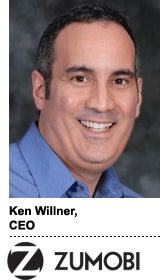
 Zumobi, a Seattle-based mobile media and advertising technology company that supplies integrated app content to brands and publishers, launched Wednesday the Zumobi Brand Integration Platform for Marketers.
Zumobi operates premium mobile app network The Zumobi Network and has worked with publishing partners like Hearst Digital Media and MSN to monetize its mobile apps through its rich media platform and developer kits.
One of the traditional challenges app developers face is cracking the code on user retention and in-app engagement, but Zumobi CEO Ken Willner says this is where the company is focused on helping mobile marketers make headway. He spoke with AdExchanger.
AdExchanger: Can you bring us up to speed on Zumobi and what you do?
KEN WILLNER: Zumobi has been in the mobile apps space close to eight years now and pre-iPhone. We are able to create very immersive content and brand experiences in mobile applications. The common phrasing now is “content marketing” or “native advertising,“ but essentially we’re creating content and advertising experiences that help [marketers] deliver through our platform inside of mobile applications.

What’s next?
The next wrinkle or evolution of our platform is we’ve been asked over the last six to eight months by some of our brand clients about helping them enable these kinds of rich branded content experiences inside of their own apps. So the nuance here is that whereas before, we were providing a paid media opportunity, we’re now extending that to owned media and brands are using their own apps as a canvas to communicate with their customers using content and that’s the new extension of the platform.
What need does this address?
Consumer-facing Fortune 500 companies like banks, airlines, hotels and pharma, [all] have their own mobile and tablet applications. They typically got those out to market quickly as utility apps, with functionality like “book a hotel room, check your account balance, print out your boarding pass.” They were always quite functional and still are, but haven’t provided a mechanism for those companies to talk to, cross-sell or upsell to their customers before – some of these CRM capabilities – and we want to enable that through this extension of our platform.
What are the components?
The branded content module enables a brand to deliver RSS feeds or video or any kind of branded content to customers. The Partner Marketing module is quite important because most brands today have third-party marketing relationships such an airline and a credit card partner, or a destination hotel partner. This module is database-driven and enables these brands to enable their marketing partners to deliver offers to their user base in a very selective, targeted way and through cross-promotion. The third module is the mobile media module, which is an ad-serve product that can deliver a derivative of digital ad campaigns which might be running or even those same campaigns, inside of a brand’s own app to their own customer base. This can also include blogs or social content, but any form of content they want to deliver their own content.
Zumobi launched mobile video ad formats in the fall that brand clients Nissan and Corona have used. What’s the biggest issue with mobile video?
The uptake on that unit has been pretty compelling. The thesis behind that was that mobile video in particular is pretty hot. Advertisers are quite interested in that format, but inventory is constrained. There’s a certain amount of video in mobile and on the Web in general and a lot of it is pre- or post-roll and what we wanted to do with that product was create video inventory where it didn’t exist prior, so we could help publishers create an offering that brand advertisers could take advantage of, that was not a blocking interstitial. Interstitials tend to annoy users, particularly if you block all the content and it’s a midpoint between a blocking interstitial and a pre-roll so it auto plays video but in a way that can be closed out easily and does not take over a whole page. That way if a user is interested they can click through, go to a full landing page and get the whole video experience. We wanted to create a unit that didn’t exist before that has all the good characteristics of delivering video for advertisers, but not the quality of taking over the content experience, which is a problem.
What’s the greatest challenge for brand advertisers with in-app messaging and content?
There are a lot of form factors, devices, screens and operating systems. There is a complexity to the business in general. [One of the major problems I’ve seen is the] concepts that worked on desktop Web were immediately transported to mobile. I’m on the IAB Native Advertising committee, and I have to say that brand advertisers have woken up to the mobile opportunity and are realizing that there is a lot more that can be done on this smaller screen if you have the thought leadership and ambition to do it.
Can you talk about your customer base, impressions served and headcount?
On the advertising side, I can say with confidence that 75% of (companies on the 100 Leading National Advertisers Index) have used Zumobi in one form or another. On the publisher side, we think about it in two ways. We have direct, first-party publishing relationships where we have direct relationships with the media companies where we produced the app ourselves, or we have our software development kit (SDK) inside of the app, and through our direct and extended network, we probably have a couple million premium uniques there and a couple hundred million impressions. And then we have third-party relationships where we can extend our ad units and advertising capabilities into any IAB/MRAID (Mobile Rich Media Ad Interface Definitions)-compliant app. Over the last four years, we have seen significant growth – certainly in the high double-digit percentages, but I can’t really disclose profitability and revenues. We are at 28 people now.







