
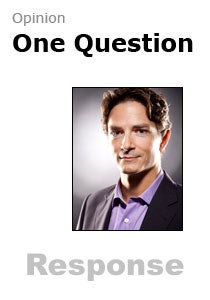
 Jason Lynn is Chief Strategy Officer of interclick, an online advertising company.
Lynn is responding to Hooman Radfar of Clearspring who authored a One Question piece recently – “What Is The Biggest Misconception About The Use Of Data For Ad Targeting?“…
Leaders in the data targeting business uttered a collective ‘Amen’ to Hooman Radfar’s assertion that many data types and sources have to be considered for any marketing campaign.
Mr. Radfar’s comments address a common misconception in the industry. Too often, marketers approach their online data in the exact same manner that they do offline data yet these data sets are fundamentally unique and should be treated as such. It’s a familiar scenario – a marketer insists on a specific audience strategy based on an offline segmentation model. Consequently, the campaign results show no lift over campaigns which do not use data, leading the marketers to conclude that “data doesn’t work.” There are few instances where data minimally benefits a campaign; however, nine times out of ten, the problem is improper selection of the audience data or an inappropriate audience selection process which stems from “traditional” marketing analytic practices.

“Traditional” marketing analytics focus on accurately describing consumers and ”success audiences” such as users who engaged with an ad, watched a video to completion, made a purchase, etc. These analytics concentrate on what engaged consumers look like, and technically serve as a classification exercise. In contrast, the selection of targeting data answers a question of prediction. It addresses which data will make creative and media more effective and how will an audience respond to certain types of targeting.
On a technical level, classification and prediction are extremely similar, which can be confusing. In most cases, the algorithms used to address both are the exactly same, but from a process standpoint, classification and prediction are different and should be articulated separately. Marketers should have descriptive insights about their consumers and an audience targeting portfolio with predictive values. This is a deliberate separation of correlation and causation. Without an explicit prediction, it’s extremely difficult to choose the data which will improve the effectiveness of a campaign and correctly value it.
Some brand marketers will say this mainly applies to direct response campaigns. This is only the case if you conduct campaigns without any measurement whatsoever. Data can and should be used leveraged in branding, and given that campaigns can leverage prediction on any level within the purchase funnel – attention, interest, desire, or action – it should be viewed as another tool, rather than a niche solution.
Overall, handling online data is very challenging and requires new approaches to realize its full value. While there are many unique lessons to learn about online data, one lasting standard remains true: “make the model fit the data, not the data fit the model.”
Follow interclick (@interclick) and AdExchanger.com (@adexchanger.com) on Twitter.







