
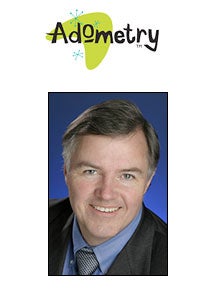
 Jim Ewel is CEO of Adometry, which provides verification and effectiveness metrics products for display advertising.
AdExchanger.com: What gave the team the idea for Adometry? And, what problem is Adometry solving?
JE: Our founders, John Dietz and Rob Perrier, had built a large-scale ad server for a major publisher. They understood that the kind of information that they could gather would be very useful to advertisers, both for verification purposes and to help them understand where best to spend their advertising dollars. This led them to found Adometry back in 2008.
The problem we’re solving is essentially one of transparency and trust. Much has been made of the fact that fewer advertising dollars go to online than you would expect, given the amount of time that people spend online. We believe, as do many others, that it will take greater levels of transparency and trust for advertisers to move more advertising dollars into online.
We’ve all seen what transparency, trust and clear effectiveness measures have done for search; we believe that display advertising can also benefit from similar kinds of tools and measurement.

How do you see optimizing the effectiveness of ads and verification of compliance related to each other? Is attribution modeling mixed in here?
In order for advertisers to devote more of their marketing budgets to online display advertising, they need three things: trust that their brands are not going to be damaged by appearing next to inappropriate content, confidence that they’re getting what they paid for (verification), and metrics that show that the ads were effective in reaching the marketer’s goals. You can’t have the first two and ignore the third.
In regards to attribution modeling, we’re not trying to compete with attribution products like Clearsaleing or Visual IQ, which track offline as well as online interactions. On the other hand, we are providing data to help the marketer understand which of their display ads, in which contexts, at what frequency, are most effective. We’re attributing, if you will, conversions to particular ads and sites, and showing marketers which ones contribute to their goals.
Are you concerned regarding the many players who have popped up in the verification/validation space such as AdSafe Media, DoubleVerify, Mpire’s AdXpose and others? How do you differentiate?
We see the high number of players entering the market as a good thing; it validates the need and the high level of interest on the part of marketers, agencies and networks in ad verification.
We differentiate ourselves in several ways: first, we’re a completely independent 3rd-party and have no conflicts of interest. Although we resell through some ad networks, we don’t have our own network or sell media. We can provide consistent ad verification across any publisher, portal or ad network, giving you an unbiased, apples-to-apples view across all of them.
Second, we’re the only vendor that offers both verification and effectiveness metrics, and as I said above, I think it’s going to take both for advertisers to move more dollars into online display advertising.
Third, our product is by far the most intuitive and easiest to use. Media buyers and traffickers already have their plates full – they don’t need another complicated interface or a difficult to implement ad verification tool. We make the process as easy and streamlined as possible, both through our product offering and our customer service.
What about an Adometry media practice? Given the tools you have in-house, this would seem to be a potential opportunity?
We’ve thought about it, but decided that we need to focus on the product business. We are looking at some partnerships in this area, but we have no plans to have our own media practice.
How is your nearly 20 years of experience at Go Ahead Software and Microsoft informing the decisions you’re making today at Adometry? Any adjustment getting in the saddle of a new startup?
A lot of the skills that I picked up at Microsoft and GoAhead apply directly: building a team, taking care of customers, negotiating partnerships, etc. The biggest challenge has been to learn the specifics of the advertising world. Fortunately, I’m surrounded by a team that has decades of experience in advertising. They’ve taught me a lot.
Please discuss how you price your product line. And, any early traction you can share – such as client momentum (vertical strengths, deal size, etc.) – with Veracity?
We have two products. Our entry-level product, Integrity, provides basic ad verification. It is aimed primarily at networks that want to provide their clients with independent, 3rd party ad verification at a reasonable price. Veracity, our flagship product, includes everything in Integrity, but it also adds effectiveness metrics and provides greater transparency to the entire campaign. It is aimed primarily at agencies and marketers. Some performance networks may also choose Veracity. Both products are priced on a CPM basis, tiered according to monthly volume. We don’t charge setup fees, user fees or have a monthly minimum.
In terms of traction, we’ve announced a few deals and we’ll announce a few more in the next few weeks. But most of our customers prefer to remain anonymous, and we haven’t announced them. I can say that with the deals that we’ve recently concluded and are currently negotiating, we should be profitable in the next quarter, which will allow us to continue to grow and hire additional staff.
What is the Seattle tech scene like? Strengths, weaknesses?
The Seattle tech scene is fantastic. It’s a great technology town with companies like Microsoft, Amazon, Boeing, Zillow and lots of smaller startups that you’ve probably never heard of. One of our startups, Picnik. just got acquired by Google this week. It’s also a center for advertising innovation with companies like aQuantive (acquired by Microsoft), BlueKai, Audience Science, AdReady and others. There are a ton of events every week that provide the opportunity to meet other entrepreneurs and potential employees. In fact, I met my partners through one of the entrepreneurial coffees here in town. If there is one weakness, I’d say that the connection between Seattle VCs and Seattle entrepreneurs isn’t as strong as it could be. Many of the VCs invest heavily in non-Seattle companies, and many Seattle entrepreneurs go elsewhere to seek their funding.
A year from now, generally speaking, what milestones would you like to have seen Adometry accomplish?
Right now, we’re focused on customer satisfaction, growth and profitability. Over the next year, this market will shake out; it can’t support 9-10 profitable players. 2-3 players will rise to the top, and we fully intend to be one of those players.
Follow Adometry (@Adometry) and AdExchanger.com (@adexchanger) on Twitter.






