
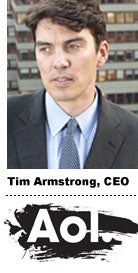
 AOL’s Q4 results had a number of positives, not least of which was a return to overall revenue growth for the first time in eight long years. And yet, Q4 saw the company’s display ad dollars slip further, with numbers in that segment flat globally and down 3% in the U.S. Read the release.
For advertising, AOL could boast that search revenues were 20% higher than Q4 2011, and international display picked up the slack for the domestic side. But those areas are relatively small and will not make up for the declining dial-up subscription business, which is where AOL originated and which still provides most of the profits.
In a conference call with analysts, CEO Tim Armstrong promised brighter days for display, especially as the company sharpens its concentration on video, mobile and programmatic, the latter as evidenced in this week’s rebranding of its Advertising.com Group as AOL Networks.
“We have walked through the valley of the turnaround and have achieved growth,” Armstrong said at one point, as he told analysts that display’s performance in Q4 looked unsatisfying, but those numbers don’t tell the complete picture. “Our ad segment is profitable. After spending 20 years in digital advertising, I can tell you that the ad business is more successful than what you see.”

AOL lost share of the display ad market in 2012, according to eMarketer, accounting for just 3.6% of display revenues in the U.S. — down from 4.3% in 2011. To put those numbers in further context, Google earned more U.S. display dollars than any other company last year, grabbing 15.4% of the $15 billion U.S. display ad market, the researcher said. Facebook took home a slightly lower share, with 14.4%.
AOL has also lost share in the overall domestic digital ad market in recent years. The company went from a 3.3% share of all U.S. digital ad revenues in 2010 to a 2.8% share in 2011 and just 2.5% last year, eMarketer said. Yahoo remains No. 2 behind Google in terms of market share — Google accounts for more than 41% of all digital ad revenues in the U.S., eMarketer estimates — ahead of Facebook, whose share rose to 5.8% in 2012.
Armstrong attempted to blunt that present reality by pointing to investment in the AOL advertising stack and its content businesses, including HuffPost Live, its video news channel, and its stable of websites like Techcrunch and Engadget. “Before, the company was focused on commoditized ad units, but we’ve moved to video, which gives us access to higher-CPM, higher-margin brand dollars. On the managed service side, we’re providing white label services to agency trading desks. That’s a business we weren’t involved in two years ago.”
Expect more white label solutions for agencies and publishers over the course of this year, Armstrong said, though he didn’t delve into specifics. Keeping his eye — and that of restive analysts and investors — on the future, Armstrong discussed the influence of programmatic beyond PC-based display ads to encompassing not just mobile, but TV ad budgets in future years. The message is that sticking with AOL will mean that despite bumps in the road — a charitable characterization of its display performance last quarter — the dividends and the higher margins will certainly materialize.
“Estimates of the share of ad dollars flowing into [programmatic] range from 7 and 20%,” Armstrong said. “The point is, anything that can be machine traded, will eventually go in that direction. TV ad budgets will migrate to programmatic and those buys will be high-value, high-CPM brand dollars. And we’re positioned to capitalize on that.”
In the meantime, as the industry awaits TV’s programmatic moment, AOL will continue to develop its mobile ad capabilities within a programmatic framework. Here too, Armstrong and COO Artie Minson noted consumer usage has well out-paced ad spending. But they believe they can close the gap with increased focused on mobile targeting that doesn’t rely on PC-based cookies, especially since Apple’s iOS doesn’t permit these kinds of tracking tools.
“There’s an identity war going on right now,” Armstrong said, referring several times to an article in The Economist this week on the business of data mining and European regulation. “We understand the data of targeting and formatting and are working on cookie-less targeting,” Armstrong said. “And we’re going to be able to do more targeting without cookies in the future.”






