
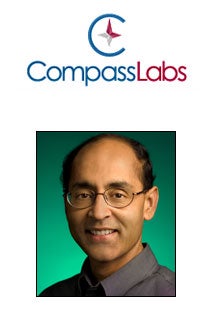
 Dilip Venkatachari is CEO and co-founder of Compass Labs, a real-time targeting technology company.
AdExchanger.com: Please share some background on you. And, where did the idea for Compass Labs come from?
Prior to co-founding Compass Labs, I led Google’s mobile monetization business and had responsibility for all of PayPal’s risk and fraud management, card and bank processing relationships, and regulatory compliance. Compass Labs is not my first start-up. I also co-founded and led two successful start-up companies – CashEdge and CommerceSoft – after stints at McKinsey and Goldman Sachs.
As a casual user of social networks, I noticed people beginning to use Facebook and Twitter to ask product questions of their friends and total strangers. It seemed that people were unable to find what they wanted by themselves, despite the wealth of information available online, and so were turning to others for help. Arjun Jayaram, who was at that time working on product search, Kittu Kolluri, a general partner at NEA, and Ajay Vashee, another NEA venture capitalist, joined me in brainstorming the potential of a solution. The scale and scope of this business opportunity gradually became clear – and then we set about forming the company and fleshing out the strategy and technology.
What problem is Compass Labs solving?

Compass Labs identifies which products and/or services a specific user is interested in purchasing, and connects that user with an advertiser or merchant.
To do this, Compass Labs extracts meaning from users’ social conversations about products and services. Specifically, Compass Labs can identify who is about to buy a product or service, which product or service are they about to buy, what are the user’s interests, and what does the user feel about specific products and services
Describe how Compass Labs identifies purchase intent? Where in the purchase funnel is intent derived from social streams/messages? How does this compare with Web search?
Compass Labs monitors social streams 24/7 and scores each user and each social stream for readiness-to-buy. For example, a readiness-to-buy score of 95 indicates that the user is very likely to buy the product in the immediate term – i.e. the user is an imminent buyer. On the other hand, a readiness-to-buy score of 70 indicates that the user is seriously considering purchase but is still trying to decide, say, which brand to purchase. Thus, we can identify the user’s state of readiness.
These scores then make it possible for different types of advertisers to efficiently target the right customers. For example, a merchant will be interested in targeting imminent buyers (e.g. a score of 95), while a brand like Sony would be interested in targeting people who are trying to identify the brand preferences (e.g. a score of 70).
Users are increasingly asking product and service questions on social media before they conduct a Web search. Through analyzing these interactions across public networking sites, Compass Labs is able to identify users who are about to buy even before they visit a search engine. This means that advertisers using Compass Labs are able to reach users before Google.
Who/what is your target market?
Our target markets is the online advertiser – both brand advertisers and performance advertisers—as well as publishers (both social media clients like Seesmic, and web publishers like the NY Times) who want to maximize their monetization.
Will you use data exchanges to sell your data?
Possibly. We are evaluating this opportunity.
And, in addition to your datasets, do you plan on selling media? Why or why not?
Our information includes targeting information (which is of value to advertisers), and social content (e.g. who are the “experts” on each specific product, what do users think about specific products or specific merchants, etc). We will be offering this high value social content to publishers (so that they can increase user engagement).
How will you access social media conversations through Facebook and Twitter, for example? And, how does this work with their terms of service?
We access the social streams via APIs provided by services like Twitter. In this capacity, we only cull data from the users that have made their information, including their Tweet streams and Status Updates publicly available. Our access is fully within the parameters determined in the Twitter and Facebook Terms of Service.
Is the product available today?
Yes, we are able to deliver this product today and is priced on CPC or CPA basis for performance advertisements, and CPM basis for brand ads. Prices are competitive with online equivalents, meaning CPC for a category will be similar to the related AdWords average price.
Given the nature of conversations, how will you balance what’s public and what’s private?
We only use the parts of the conversations that have been marked as public by the user. We do not attempt to access any private conversations.
A year from now, what milestones would you like to have seen Compass Labs accomplish?
A year from now, we hope to have built a strong base of advertisers and publishers, established ourselves as the market leader, and realized strong revenues and margins.
Follow AdExchanger.com (@adexchanger) on Twitter.






