

The fox can’t guard the chicken run.
GroupM is not down with Facebook and Google’s reticence around third-party verification tags.
“You can’t measure yourself,” said John Montgomery, COO of GroupM Interaction, North America, speaking at AdExchanger’s Clean Ads I/O conference in New York City on Wednesday.
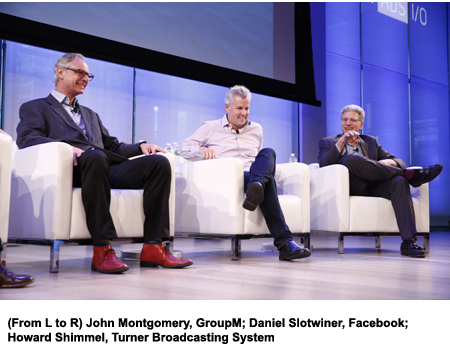
The fact that Facebook is working closely with the Media Rating Council to accredit its tech has little to do with GroupM’s stance, said Montgomery, who took the stage alongside Daniel Slotwiner, Facebook’s director of advertising research, and Howard Shimmel, chief research officer at Turner Broadcasting System.
“Whenever we have these third-party discussions with [Facebook and Google] they say, ‘Our technology is so good we can probably measure what’s appeared and what’s viewable better than you can’ – but that’s not the point,” Montgomery said. “It’s not good governance to measure yourself.”
Slotwiner, as to be expected, saw the situation differently. Asked whether Facebook can get away with things that other publishers can’t because of its reach, size and influence, Slotwiner strenuously demurred.
“I don’t feel like we’re getting a pass,” Slotwiner said. “I’m not saying, ‘Trust us,’ I’m saying we need to be transparent about how much is in view and what we’re delivering. There needs to be transparent measurement systems in place so that [our] value is not a black box.”
In other words, third-party tags aren’t welcome on Facebook, but other forms of independent third-party verification are. Yahoo, by contrast, announced Wednesday that it would partner with verification vendors, including DoubleVerify, Integral Ad Science, comScore, Moat and others to bring third-party tagging onto its O&O and network sites.

Also muddying the waters is the fact that Facebook and GroupM have different definitions of viewability. Whereas Facebook says an ad is viewable the moment even a portion of it enters a user’s screen, GroupM’s line couldn’t be harder – 100% in view for display and 100% in view for video with audio on and autoplay off. [Yet both are departures from the MRC’s standard of 50% of pixels in view for one second for display and two seconds for video.]
But it’s Facebook’s market dominance that allows it to sustain its particular viewability standard, Montgomery said.
“There are a couple of must-buy media who are able to push back and say, ‘We’re not going to take your tags, we’re not going to look at independent measurement and we’re not going to take your viewability standards … and I think you really are getting a pass on it,” Montgomery said, addressing Slotwiner, noting that when a platform has nearly 1.5 billion users, almost anything it does will have an impact.
Montgomery said he recently took a straw poll of the trading leads at GroupM and each one said that Facebook’s stance on viewability was a major factor holding them back from spending more on the platform – although, “$4.3 billion a quarter isn’t a bad number,” Montgomery quipped.
But the needs of media buyers alone don’t sway Facebook, Slotwiner said.
“As far as we’re concerned, that’s not how you make a decision about what to do,” he said. “Of course we want more investment on our platform, but we don’t want it at the long-term cost of value and customer experience. We might not have [more than 1] billion users if we made a bunch of decisions on that basis.”
 The debate crystallized around the notion of autoplay video. Facebook loves it, GroupM doesn’t.
According to recent research commissioned by Nielsen on behalf of Facebook, “the moment a video ad was viewed (even before one second), lift happened across ad recall, brand awareness and purchase consideration.” But that’s nowhere near enough to satisfy GroupM and its clients.
“It’s not that we’re rooted in the past,” Montgomery said. “We fully understand that short-form mobile video is coming [and] our creative directors are having to create around that – having a celebrity in the video within the first two seconds because that works better, for example. But it doesn’t mean Facebook is doing a good thing. It means that it’s a high-reach medium and we’re adapting.”
Update: video added June 4.








