

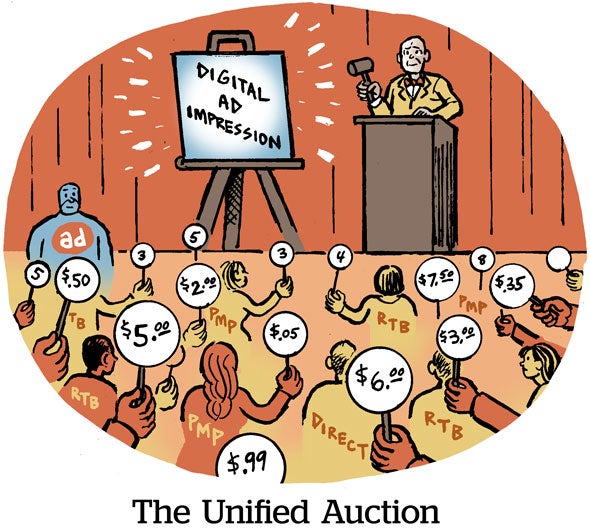
 Google will move to first-price auctions for Google Ad Manager, its publisher exchange and ad server, by the end of 2019. At that time, it will also run a single, unified auction and remove last look, ceding a key advantage Google held in a second-price world.
Google Ad Manager will be the last major exchange to switch to first-price auctions. Other exchanges tested or rolled out first-price auctions starting in 2017.
In a first-price auction, a buyer with a winning $7 CPM bid pays $7 minus fees – a simple, transparent approach. Buyers can use bid-shading algorithms to ensure they don’t overpay. Since most exchanges have already switched to first-price auctions, DSPs, including Google’s own DV360, use bid-shading algorithms to optimize bids.
In the past, that same winning $7 CPM bid might compete with other buyers or a floor set by an exchange or publisher. Auction games constantly emerged to help sellers recover the huge difference they saw between the bid price and the clearing price. Buyers might end up averaging a lower CPM – say a $5 CPM – but didn’t know why, or how much went to a publisher or to hidden fees.
First-price auctions will increase transparency, reduce operational complexity for sellers and make it easier for buyers and agencies to properly value inventory, Sam Cox, Google group product manager, wrote in a blog post. The “increasing intricacy” of the programmatic marketplace necessitated the switch to first-price auctions.

“A single ad can pass through a mix of over 10 different auctions, with different rules, before a winning bid price is selected and an ad is served,” Cox said.
Google Ad Manager is responsible for at least two of those auctions, but will unify its multi-stage auctions as part of the change.
In the current setup, higher bidders sometimes lose because they participate in the first auction instead of the final one. For example, a buyer with a $7 bid competing against a $3 bid will clear at $3.01, which seems great until that buyer loses to a $4 bid in Google’s exchange bidding auction. In the future, all three bids will compete at the same time, which will allow the highest bidder to win.
No more last look
Switching to first-price auctions also means that Google will say goodbye to last look, which isn’t compatible with first-price auctions.
“Last look” ostensibly gave buyers better access to inventory, but it was also a privilege Google gave itself. After an auction, Google asserted the right to pay a penny more to win the impression, which allowed its own AdWords and DSP buyers to boost their win rates and secure valuable inventory at favorable prices. The privilege has long rankled publishers who wanted to make their own decisions about who to prioritize in their ad stack.
The move to first-price auctions also means that publishers won’t need to invest in complex flooring strategies.
Programmatic auctions sometimes lack enough bidders to drive up prices for publishers, which is why publishers used flooring strategies, to ensure they weren’t selling diamonds at cubic zirconia prices. Publishers will need to “rethink how they use price floors” in advance of this switch, Cox advised in the blog post. Google is creating a unified pricing tool said to simplify this process, according to a publisher briefed on the change.
Google isn’t abandoning second-price auctions for products where it controls the end-to-end buying experience. YouTube, Google Search, AdSense for Search and other Google properties will continue to use second-price auctions.
The switch to first-price auctions will begin with a small percentage of traffic before expanding to meet Google’s deadline to become 100% first price by the end of the year.








