
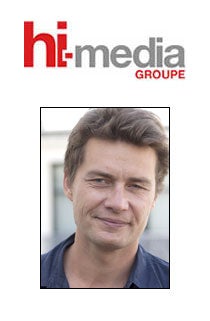
 Cyril Zimmermann is CEO of Paris-based Hi-Media, an online ad network and publisher.
On Wednesday, the company announced that it would launch its own ad exchange through the AppNexus platform. Read the release (PDF).
AdExchanger.com: Tell us a little bit about Hi Media.
CZ: Hi-Media is now an old story. I created the company 15 years ago. We operate two businesses. One is the online advertising business. The other one is micro or mobile payment business. Last year, we did something like $300 million in revenues – with revenue evenly divided between the two businesses. We are a public company, profitable, listed on the Paris Stock Exchange for the past 10 years and have 500 employees in nine countries in Europe, with a small office in San Francisco and a venture in Brazil, as well.
The link between both businesses is that we monetize content for digital goods producers and publishers.
Regarding the advertising business, is Hi Media a publisher?
We are a publisher and operate ad sales across owned and operated websites. That’s a small part of the business. But, the largest part of the business is third‑party inventory. We aggregate several thousand websites which are part of the top 300 Nielsen or Comscore rankings of each country across nine countries in Europe. 90 percent of the display revenue that we generate is through third‑party websites that we aggregate on an exclusive basis.

We have always been sticking to that model for 15 years and I think it’s the reason why we still have a business.
With our AppNexus partnership, we are going to be able to leverage this exclusive inventory and add any kind of inventory that any publisher or any ad network would like to bring into the ad exchange.
So, you’re essentially using AppNexus as a sell‑side platform?
Correct. On the supply side, we have teams that have been striking deals with publishers for a few years. We are going to migrate all of our inventory and partners to AppNexus’ platform, so that all the ads will be served in and be biddable in real time. We want to provide in one step the liquidity that that marketplace should have.
We will be connected to all of the DSPs, and all of the other buyers in the market. We’ll also have direct salesforce because, for the moment, the ultimate market share is quite small in Europe in comparison to what you have in the US.
Given the regulatory environment in the European Union, how much can you do regarding data‑driven advertising? Do you feel restricted at all?
We’re not. I think that we’re able to do whatever American players are able to do in the American market for the moment. At the European Commission level, there has been some discussion – that we’ve been taking part in inside the IAB Europe – [about regulating] data collection and the tracking of the web users. For the moment, the European Commission is asking players in the market to act in a self‑regulated way.
[If anything], it’s more about European bodies putting some pressure on the different players of the market, so that they can have a full and clear transparency policy with end users.
How were you selling your media before you decided to create your exchange through AppNexus?
We were using two solutions. One was ADTECH, AOL technology. The other one was a proprietary technology that we’ve been developing to run performance campaigns. 60 percent of our business is display CPM business and 40 percent is performance-based.
With your new ad exchange, will you need to still pursue demand?
We’ve still got to do it. I think that some of the players in the market have this fantasy where technology and trading desks are delivering the sales by themselves. When I look at Google, Yahoo – and also Yahoo, Microsoft and AOL joining forces together – it looks like they can provide liquidity. But, when it comes to who is delivering the revenues and who is making the sales, it looks like there is [no need for] salespeople and everything can be run by the machine.
I think that we are pretty far away from that in Europe, maybe in the US, too. I think that what is important for us is that we still have relationships. That’s in our DNA, to have relationships with the advertisers, to have relationships with the media buyers’ trading desks.
What would you say in terms how you try to differentiate your inventory offering?
We are unique because there are few global players who are able to address the whole European market. Second, I think that with ad exchanges, for now, you can find a lot of inventory, but you can’t find a lot of premium inventory. What we’ll bring to the market is not going to be remnant inventory or some crappy part of unsuccessful portals.
We’re going to plug into Top 300 websites from France, Germany, Spain, Italy, UK, Netherlands, Belgium and Portugal. We really want to push forward with our ad exchange. Advertisers will have the opportunity to target with the data or see where they’re buying. I think this is one of the challenges of the ad exchange.
Data is one thing. But I think that advertisers are still really interested in seeing where their advertisements are going.
What are some of the goals that you’re looking at down the road?
I will be very high level – and maybe a little bit ambitious. We don’t believe that there are going to be 10 ad exchanges per country in Europe. There may be just two or three. We want to be the alternative to Google Ad Exchange in every market.
By John Ebbert








