

 Display failed to close the gap with search in 2011, according to the Interactive Advertising Bureau’s full-year ad spending report, released today (full report). Both categories grew dramatically during the year, but search spending clearly has the bigger head of steam, says the IAB and research partner PricewaterhouseCoopers.
PwC estimates search revenues totaled $14.8 billion for the year, nearly half the $31 billion that went to all online ads in 2011. That’s a rise of 27 percent compared with the $11.7 billion search drew in 2010.
Meanwhile display-related ad revenues – consisting of digital video, “banners,” sponsorships and rich media – grew 15 percent, slightly more than half the rate of search. That growth rate is extremely healthy compared to nearly any other medium. For example, in 2011 the two best-performing offline channels were cable and spot TV, which grew 4.8 percent and 5.6 percent respectively, per Nielsen. Display ad spending grew three times as fast.
Full-year display revenues totaled $11.1 billion or 35 percent of 2011 revenues. Breaking it down further, marketers spent $6.8 billion on banner ads, $1.3 billion on rich media formats, $1.8 billion on digital video, and $1.1 billion on sponsorships.

Chart source: IAB/PwC

Prices Fall Slightly
Average CPMs declined slightly in 2011 but less than the year prior. According to the study, 2010 CPMs fell $0.64 on average, while the 2011 decline was $0.10. From this the IAB offered two interpretations: either (1) prices stabilized in 2011 as the marketplace learned to affix a consistent value to the media product; or (2) CPMs are turning around and prices will go up next year.
Under the second assumption, “as revenue continues to grow, CPMs are likely to increase after this period of flattening,” offered Sherrill Mane, the IAB’s SVP of research, analytics, and measurement.
A third conclusion, not offered by the IAB or PwC, is that the rise of programmatic ad buying has created new revenue streams for publishers and helped ameliorate a crisis of over-supply that has driven down prices in recent years.
Examined on its own, mobile was the year’s biggest story. The mobile channel surged 149 percent during to $1.6 billion, way faster than any other channel.
Brand metrics are the rage lately, with new momentum behind such brand-centered solutions as online GRP and the “viewable impression” metric. But online ad buyers still favor performance pricing, the PwC report shows, and in fact are moving more in that direction. Performance pricing increased from 62 percent in 2010 to 65 percent in 2011, while CPM retreated from 33 to 31 percent. “We are garnering more brand spend, just not at the [2010] clip,” said Mane.
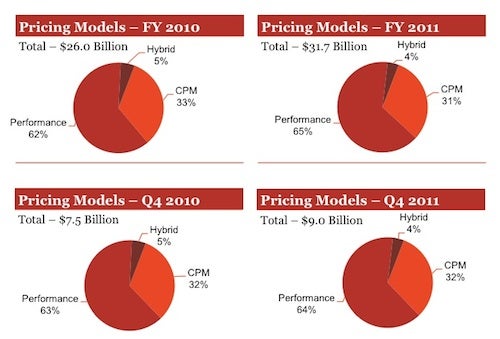
Chart source: IAB/PwC
IAB CEO Randall Rothenberg weighed in, “We tend to be a medium that has sold below the line. It’s only during the last couple years that we’ve moved more upstream and into brand advertising.”
PwC has tracked online ad spending on behalf of the IAB going back to 1996. Their approach is to conduct surveys with leading industry players, including publishers, ad networks, mobile providers, email service providers, and others. It supplements their aggregated responses with public disclosures from ad sellers.
It should be noted the IAB’s numbers disagree with a spending report Kantar issued in March, which found display and search both tumbled in Q4 2011.
By Zach Rodgers






