


Cookies increase ad prices by a factor of two to three, according to the majority of research – a fact that marketing professor Garrett Johnson wants front and center as the industry weighs decisions about the cookie’s future.
So he’s taken to Twitter, chiming in on topics like Google’s recent study that showed a 52% reduction in publisher revenue when cookies were removed. The number happens to exactly match the 52% price reduction in a study that Johnson co-authored with Scott K. Shriver and Shaoyin Du.
That study looked at the 0.23% of people who opted out of behavioral advertising via AdChoices, compared the revenue between the two groups, and then adjusted those numbers to account for the fact that the opt-out group might visit a different set of websites. Without behavioral targeting, prices fell by half.
Johnson, an assistant professor at Boston University Questrom School of Business, spoke to AdExchanger about the existing research on cookies and the future of behavioral advertising.

AdExchanger: What inspired you to post the literature review of cookie research on Twitter?
GARRETT JOHNSON: It’s about as fulfilling as bashing your head against a wall. But if you look at the public discussion on the value of a cookie, you hear that there is no work on the subject, or you hear about one cherry-picked study. I have been pretty aggressive in trying to point out that there are five studies on the value of the cookie, and they paint a picture that is hard to dismiss. Most of these studies find that the price of ads without cookies is two to three times lower.
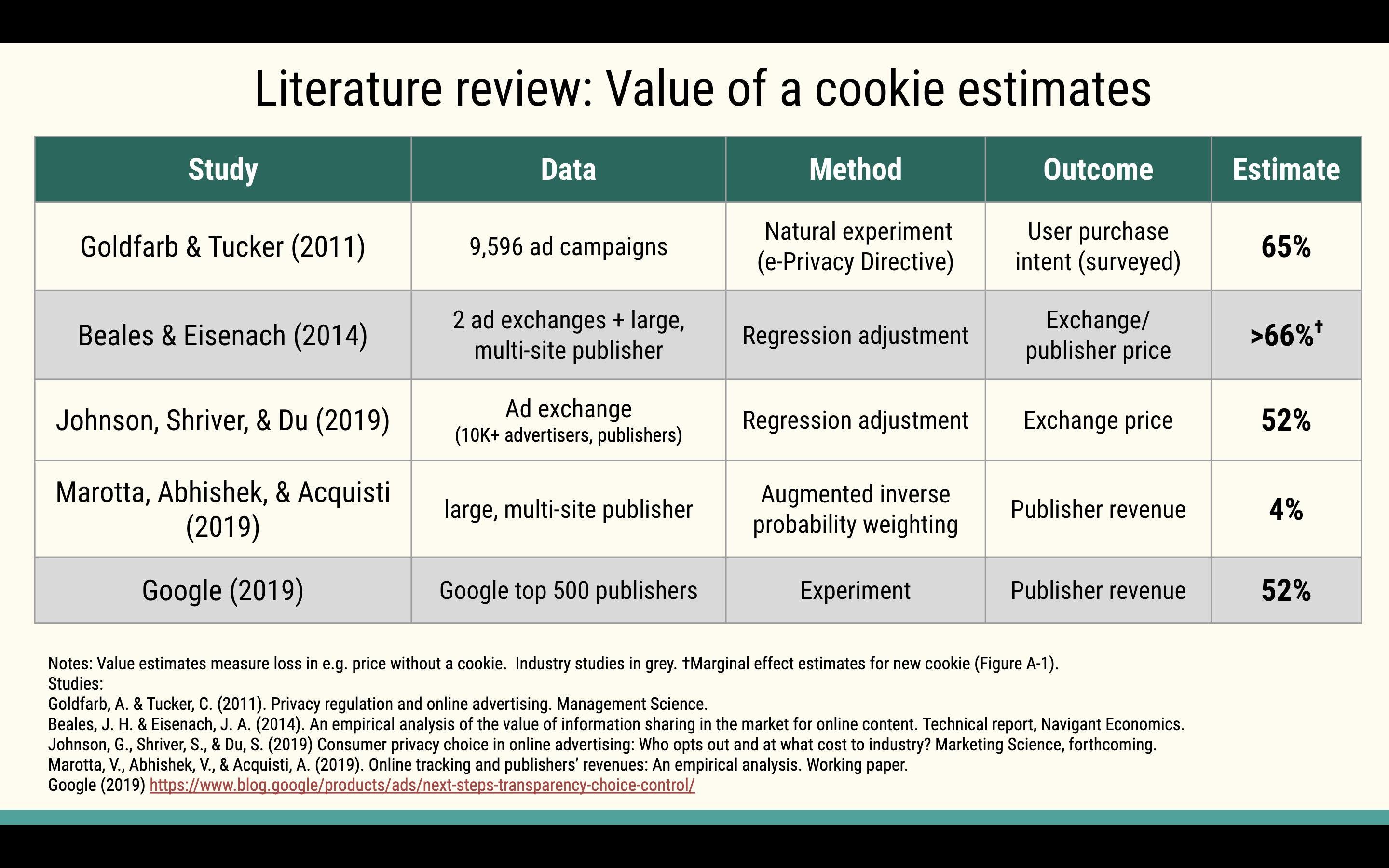
Photo credit: Garrett Johnson
There is one study that shows only a 4% decrease in revenue when third-party cookies are absent. Is that study an outlier because of any kind of alignment with anti-Google interests?
No, publishers vary in their reliance on behavioral targeting, though this figure is rather low. That study’s publisher may be a premium publisher and one that offers more valuable contextual targeting opportunities. Also, I don’t think these authors should be responsible for who is grabbing their research, and who is using it to bludgeon whom.
Your research looked at the 0.23% of people opting out. What happens when there are a lot more people that don’t have cookies?
If you get rid of cookies or behavioral targeting, you’ll see some market adjustment. Some advertisers will move to contextual targeting. Other ones will exit the market because they were going after niche audiences. For them, it’s no longer worth their time and money to hunt these people down when they’re flying blind. We may have seen some of that with Safari, but at least on desktop it has small enough volume that we haven’t yet seen the cookie apocalypse, just a slow-motion car crash on the way to that apocalypse.
What prompts advertisers to buy ads without cookies?
These advertisers are using contextual targeting and targeting users based on geography. The other part of it is brand advertisers, which are targeting their message to a broad swath of people, and care less about cookie information.
Most of the discussion about cookies focuses on targeting. But if you know you can’t measure an ad, does that decrease the value of an ad?
One of the reasons money went to digital was because of the revolution in being able to measure the value of an ad impression. If you kill cookie information, you should not take for granted that advertisers will keep spending as before, because they came to digital for those measurement benefits.
What’s the future of cookies as privacy regulations and protections step up?
It’s hard to see. We are part of the way through that slow-motion car crash, and all sorts of things are flying around. Can we find tech solutions that preserve people’s privacy and solve for this? It’s good that regulators are having some patience. But it’s also hard for people to work together on building the future, not least because the status quo has so many advantages for targeting and measurement.
This interview has been edited and condensed.
This story has been updated to correct an editing error that changed the phrasing of a question.









