

 The on-again, off-again IPO plans of Israel-based Matomy Media Group are on again.
The performance-based ad tech company began three days of so-called “conditional trading” on the London Stock Exchange on Tuesday in preparation for its official debut on Friday. It will seek to raise $70.1 million at a $347 million valuation.
Matomy previously attempted to go public, but scrapped those plans in April owing to what it called a “technicality” of London IPOs that requires a minimum of 25% of a company’s shares to be claimed by investors in the European Economic Area.
At the time it also cited the worsening environment for ad tech IPOs, exemplified by pressure on the stock prices of Tremor Media, YuMe Rocket Fuel and others. The company overcame the former obstacle by joining the London Stock Exchange’s High Growth Sector, which doesn’t require 25% EEA investment, according to a representative.
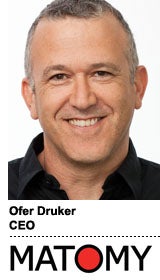
“We were disappointed to have postponed our offer earlier in the year, but we are delighted to be announcing our offer price today with such strong investor support,” CEO Ofer Drucker said in a statement. “We have continued to grow our business in the interim, including the recent successful acquisition of a majority ownership stake in the direct navigation Internet search company Team Internet.”

Matomy’s market capitalization in the current offering is slightly lower than the $400 million it sought previously.
Matomy runs an affiliate channel, a traditional ad network and a “programmatic” buying arm in partnership with AppNexus. Its revenues in 2013, 2012 and 2011 were $193.5 million, $120.1 million and $106.7 million, respectively.
In the most recent quarter for which data is available (January to March 2014), revenues grew approximately 16%, up from $49.6 million in the year-ago period. That revenue is diverse and recurring. Matomy had 1,676 active customers at the end of Q1 2014, including American Express and online casino Bwin. During the quarter it said no single customer contributed more than 7% of total revenues, and 68% of revenues came from customers it has worked with for two years or more.
The company has made five acquisitions since 2011 (Adotomi, MediaWhiz, Adperio, MobAff, and most recently, direct navigation company Team Internet). It has raised a total of $17 million in venture capital.








