 With print revenues falling faster and online ad dollars failing to fill the void, publishers have increasingly turned to paywalls. As a Guardian UK piece noted this week, 11 of the top 20 U.S. newspapers are either currently asking users for cash to access content, or are about to embark on it.
Enliken, a company founded in August 2011, has been working to get its paywall option off the ground for the past month — a considerable pivot from its previous product that allowed people to donate the value of their data to a nonprofit — and it claims to have some takers. But instead of asking users to pay cash to enter a website, its system merely seeks users willing to share their data. We followed up with Marc Guldimann, Enliken’s founder and CEO (see our last discussion here), to hear why this idea might finally take off in 2013.

The company is rolling out a new “attribution tool” over the next few weeks that is designed to make the data that advertisers rely on more dimensional and relevant.
“One of the great things about truly complete data is not only can you build out hyper targeted audiences, but it’s possible to measure the actual impact of a campaign online,” Guldimann said. “Publishers who use Enliken can measure their audience’s behavior across social, search and retail. With the resulting data it’s possible to connect ad exposures, clicks and engagement to purchases, searches and social activity, a level of attribution that has never been possible before.”
Being able to measure and analyze audiences’ intent data across retail-related sites represents another area Enliken can potentially expand its client base.
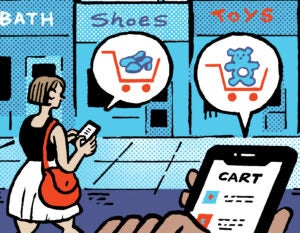
“Beyond publishers, the next obvious market for people to use their data when working with us would be e-tailers,” Guldimann said. “Consumers might trade their data with an e-tailer in exchange for a discount or a promotion, very much in the same way that you would trade your data with a publisher in order to access content. We plan to develop that model and approach over the next few months.”
The idea of using data as currency, and the paywall model as the vehicle for that currency, emerged from Guldimann’s time at ad tech company Spongecell. That previous company started off managing calendars and other types of “event-based technology.” Eventually, it morphed into a rich media company similar to Eyeblaster or PointRoll. “When I was there, I saw how our ad units were being targeted,” he said. “We saw behavioral. We saw demographic. We saw contextual. I really bought into the vision of using data to put the right ad in front of the right person at the right time, but the results just never panned out. We never saw this amazing performance that you would expect.”
When he left Spongecell in early 2011, he decided that the problem could be a profitable one to solve.
“The data that was being used to target these ads is of pretty specious quality at times,” Guldimann said. “What we also realized is that the only party who’s not sort of involved in the conversation around how data is gathered – and how it’s used – is the individual. The actual creator of the raw material, in most cases, has no say in how it’s used and has no visibility and there’s no transparency at all. So that was sort of the impetus behind starting Enliken — to bring individuals into the conversation.”
Asked for a list of the publishers Enliken is working with, Guldimann demurred, saying that it was too early in the relationships with its clients to reveal any names. For the most part he said it’s a mix of small and local publishers, the kind that have seen their ad revenues get diluted by the rise of Craigslist and Google.

While the notion that paywalls and advertising can complement each other in some form, the truth is that when consumers who are used to unfettered access suddenly find themselves blocked until they make a choice, either by paying directly or through some indirect form such as agreeing to take a survey or share their data, a reduction in traffic is more than likely. Whether or not a publisher can make up for lost traffic with higher CPMs tied to engagement — people who part with something of value to experience a site are more likely to stick around and pay closer attention — is also an iffy proposition, Guldimann conceded. But that’s also why he’s pitching data over cash when it comes to his company’s paywall systems.
“I think the premise that someone is more likely to pay attention to ads because they pay for content is a stretch. In the big picture, the fact that an audience has paid to view content seems like a much smaller contributor to advertiser value than placement, context or most importantly — data about ‘who’ they are actually reaching,” he said.
In the end, he added, data may be worth more than cash to publishers, advertisers, and ultimately, consumers.