

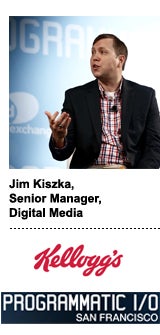
 If there’s one thing that ticks off Jim Kiszka, Kellogg’s senior manager of digital media, it’s paying extra for viewable impressions.
“I absolutely resent the fact I have to pay more for viewability,” Kiszka said Wednesday at AdExchanger’s PROGRAMMATIC.IO show in San Francisco. “I wish I could have a refund for the last 10 years on the agency side for all of the media that ran that was not viewable.”
The average viewability rate on desktop still hovers at around 48%, according to eMarketer, which means that more than half of ads never even have the chance to be seen. That number tends to “skew lower across programmatic channels,” said comScore EVP Anthony Psacharopoulos.
It’s a discouraging stat, but there’s also opportunity there, Psacharopoulos said. Kellogg, for example, has correlated an improvement in viewability with a direct impact on incremental sales.
“When you strip out nonviewable ads, the impact of digital exposure rivals that of TV,” Psacharopoulos said.
Most of Kellogg’s campaigns are awareness-based, Kiszka said, which means viewability is paramount. But guaranteed viewability usually means far higher CPMs.
“The performance is all bundled into that,” Kiszka said. “Viewability is tied to performance and that drives sales. We know that works for us and what’s why we push so hard.”

Kellogg works with comScore to run in-flight impression-level reports that break out metrics such as viewability, demographics and invalid traffic across display, mobile and video.
Krux, Kellogg’s data management platform, matches those campaign and placement-level identifiers (primarily desktop cookies) with its own universal ID to create segments around viewability and invalid traffic. The lists are then shared with Kellogg’s demand-side platform partners. Lather, rinse, repeat.
The brand is also turning to native – Kellogg uses Yahoo’s Gemini platform – to help with viewability.
Although Kellogg’s efforts overall have boosted its viewability rate to around 70%, where it stands today and with which Kiszka is pleased, the lengths to which the brand has had to go to achieve that feat still sort of grates.
The issue with paying a higher CPM for premium is that it “doesn’t fix the industry,” Kiszka said. “The fact is that this industry was built on a 50% viewable average.”
 While Kellogg was able to see an effect on in-store sales with positive ROI as a result of battling for better viewability, the rising tide won’t necessarily translate into raised ships across the board, at least in terms of incremental volume.
“In 2016 you may start to see a flattening out of ROI impact because so many other advertisers and platforms are paying attention to viewability, optimizing to it and demanding it,” said Aaron Fetters, who joined comScore as SVP of marketing solutions in July after more than four years at Kellogg.
But fighting fraud and solving for viewability, as difficult as that may be, “is low-hanging fruit,” said Jon Suarez-Davis, another recent Kellogg vet who now serves as CMO and chief strategy officer at Krux.
The next frontier is about evolving to match the nonlinear fluidity of the customer journey, said Suarez-Davis. The ad tech industry has been touting that sort of language for years, and marketers are “simply losing patience,” he said.
At the same time, brands are pushing for more insights.
“It’s no longer OK to just sign on the dotted line,” Suarez-Davis said.
At Kellogg, for example, the leadership wants to see campaign performance metrics and ROI at least every four weeks.
“We are a bit of a ticking time bomb as an industry,” Fetters said. “While programmatic has grown so dramatically and there’s been an influx of dollars, a lot of advertisers aren’t seeing growth. We’ve got to get some of these … before the dollars come away.”







